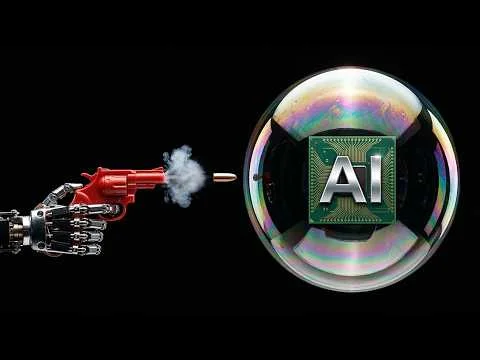
AI Crash Report: The Money Furnace
What happens when circular financing meets infrastructure obsolescence—and why 2026-2027 is when the music stops
February 3, 2026I Know This Game (And I Know When It Ends)
I spent 35 years engineering perception.
Not in the AI industry—in the industries that taught AI how to manufacture consensus. Hollywood’s dream factory. Madison Avenue’s persuasion machine. The popular culture zeitgeist apparatus.
When you’ve built carefully engineered realities for three and a half decades, you develop a particular professional skill: you can see when someone else is running the same playbook.
And right now, watching the AI industry, I’m seeing every trick I know.
Today I’m releasing a new 3-part documentary investigation: ”AI Crash Report: Part 1 — The Money Furnace.” Part 1 examines what happens when an industry builds a financial structure that requires continuous capital injection to survive—and uses circular transactions to create the appearance of demand.
This isn’t speculation. This is pattern recognition.
Let me walk you through what I found.
I’ve created a full documentary examining all of this in detail:
**”AI Crash Report: The Money Furnace”**
It covers:
- The surface numbers vs. hidden numbers
- The circular financing mechanisms (with specific examples)
- The infrastructure obsolescence problem
- The index fund concentration risk
- The missing agentic breakthrough
- The 2026-2027 timeline and trigger points
- The comparison to Cisco 2000 (and why this is worse)
I’ve approached this the same way I approached perception engineering projects: by examining the construction methods, identifying the techniques, and deconstructing how the illusion is built.
The emperor has no revenue.
And I know this because I used to sew emperor’s clothes.
The Surface Numbers Look Impressive
The AI industry wants you to see certain numbers:
- **OpenAI**: $13 billion in annualized revenue (2025)
- **Nvidia**: Most valuable company in the world at various points
- **Big Tech AI spending**: Hundreds of billions flowing into infrastructure
These are the glittering facade. The numbers designed to manufacture confidence, create momentum, justify valuations.
I recognize this approach because I used to help build facades exactly like it.
But when you look beneath the surface, the numbers tell a very different story.
The Hidden Numbers Reveal the Problem
**OpenAI’s actual financials:**
- Revenue: $13 billion annualized
- Loss: **-$11.5 billion in a single quarter**
- Annual burn rate: ~$46 billion
- Daily cash consumption: $127 million
That’s not a business model. That’s a furnace.
The spending gap—the difference between revenue and expenditure—is not closable through organic growth. Even 100% year-over-year growth doesn’t solve this arithmetic problem.
**Bain & Company’s analysis** provides the industry-wide context: to justify $2.5 trillion in infrastructure spending, the AI industry needs **$2 trillion in annual revenue.**
Current AI industry revenue: approximately $200 billion.
Gap: **$1.8 trillion.**
To close that gap, AI would need to become larger than global advertising, global pharmaceuticals, and the entire software industry—*combined.*
The math doesn’t work. And that’s before we get to the structural problems that make this bubble fundamentally different from previous tech crashes.
The Circular Financing Mechanism
Here’s where my perception engineering background becomes directly relevant: I know how to create the appearance of organic demand when actual demand doesn’t exist.
The AI industry has built a sophisticated version of this.
**The clearest example: Nvidia and CoreWeave**
Nvidia invests in CoreWeave (a cloud AI company)
CoreWeave uses that investment to buy Nvidia chips
Nvidia records those chip sales as “revenue”
The same money moves from Nvidia’s investment account to Nvidia’s revenue line. It’s circular financing presented as customer demand.
This pattern repeats throughout the industry:
- **Amazon → Anthropic → Amazon**: Amazon invests $4 billion in Anthropic. Anthropic commits to buying AWS services. Amazon records this as cloud revenue.
- **OpenAI ⇄ Nvidia**: Bidirectional investment creating artificial revenue for both companies.
- **AMD-OpenAI warrant deal**: OpenAI incentivized to spend billions on AMD chips to triple AMD’s stock price, triggering warrant vesting.
This isn’t illegal. It’s just not what “revenue” means in a functional market economy.
When investors buy from companies they’ve invested in, and those purchases are recorded as evidence of product-market fit, you’re not building a business—you’re building a sophisticated accounting illusion.
I should know. I built illusions professionally for 35 years.
The Infrastructure Time Bomb
But circular financing is only half the problem. The other half is infrastructure obsolescence.
**The GPU lifespan problem:**
- Current generation AI chips: **3-6 year useful lifespan**
- Infrastructure debt being taken on: **10-15 year payback periods**
- Time required to build data centers: **2-4 years**
Do you see the trap?
By the time a data center is built and operational, the GPUs inside it are already approaching obsolescence. The facility owes 10+ years of debt on equipment that will need replacement in 3-6 years.
This is fundamentally different from previous infrastructure investments. A fiber optic cable laid in 2000 still works today. A GPU from 2020 is already obsolete.
The dot-com bubble had overcapacity. The AI bubble has *depreciating* overcapacity.
Why This Time Is Actually Worse
The Cisco comparison is instructive. Cisco fell 89% in 18 months after the dot-com peak.
But the AI crash will go deeper for two compounding reasons:
1. Rapidly Depreciating Infrastructure
As explained above: 3-6 year hardware lifespan meets 10-15 year debt obligations. The equipment becomes obsolete while still carrying debt. This creates a self-reinforcing downward spiral.
2. Passive Investment Lock-In
Here’s the mechanism most people don’t understand:
**70% of investment portfolios** are now in passive index funds. Those index funds are market-cap weighted, which means they’re heavily concentrated in the five largest tech companies—all of which are heavily invested in AI infrastructure.
When you think you’re diversified because you own an S&P 500 index fund, you’re actually heavily concentrated in Nvidia, Microsoft, Google, Meta, and Amazon.
When Nvidia falls—and it will, because the math doesn’t work—it doesn’t just affect Nvidia shareholders. It affects everyone who thinks they’re diversified through index funds.
You can’t diversify away from concentration risk when the concentration is built into the index itself.
The dot-com crash let you flee to safety. This crash comes for your “safe” diversified portfolio.
---
## The Missing Breakthrough
All of this spending was predicated on a technological breakthrough that was supposed to justify it.
**Agentic AI**—autonomous agents that could plan and execute complex multi-step tasks without human oversight—was the promised capability that would generate the $2 trillion in annual revenue required.
It was supposed to materialize in 2025.
It didn’t.
What we got instead: enhanced autocomplete with better guardrails. Useful, certainly. Worth $2.5 trillion in infrastructure spending? No.
It’s a very sophisticated calculator—but it’s not sentient, it’s not creative, it’s not the second coming of human consciousness.
It’s math.
And when you remove the mysticism and marketing, the math doesn’t support the valuations.
When Does the Music Stop?
Multiple independent analysts, using different methodologies and coming from different perspectives, are converging on the same timeline:
**Ed Zitron** (tech industry reporter): Early 2026 to 2027
**Michael Burry** (of “The Big Short” fame): Signaling concern about AI valuations and infrastructure spending
**Cal Newport** (MIT, deep work researcher): Questioning the fundamental capabilities gap
**Patrick Boyle** (financial analyst): Analyzing the circular financing and unsustainable burn rates
**Bain & Company** (major consulting firm): Warning that $2 trillion in annual revenue is required to justify spending
These aren’t internet conspiracy theorists. These are credible analysts independently reaching similar conclusions.
The timeline: **2026-2027.**
That’s when the impossible promises come due.
The data centers that can’t be built on time.
The power infrastructure that doesn’t exist.
The revenue that requires customers who haven’t appeared.
The agentic breakthrough that didn’t materialize.
Why I’m Positioned to See This
I need to be direct about why I’m writing this.
I’m not a financial analyst. I’m not an AI researcher. I’m not a tech journalist.
I’m a perception engineer with 35 years of experience building manufactured realities across Hollywood, Madison Avenue, and popular culture.
That’s precisely why I can see this.
When you’ve spent three and a half decades constructing carefully engineered consensus, creating the appearance of organic demand, manufacturing desire where none existed—you develop a professional eye for the same techniques deployed elsewhere.
The AI industry is using every trick I know:
- Creating circular transactions that appear as organic revenue
- Moving goalposts when promised capabilities don’t materialize
- Manufacturing authority through synchronized messaging
- Building institutional momentum that’s hard to question
- Creating FOMO through scarcity narratives
- Positioning critics as missing the future
I recognize these techniques because I helped pioneer some of them in different industries.
The difference is that I was selling entertainment and products. The AI industry is selling a financial bubble.
When I watch the AI industry, I’m not seeing revolutionary technology. I’m seeing a very sophisticated performance—one I’m professionally qualified to deconstruct.
What This Means for You
If you’re invested in index funds (and statistically, you probably are), you have significant exposure to this bubble whether you know it or not.
The S&P 500 is not actually diversified when five tech companies represent such massive concentration.
When this resolves—and it will, because the math doesn’t work—your “diversified” portfolio will not protect you the way diversification protected investors in previous crashes.
I’m not a financial advisor and this isn’t financial advice. But I am someone who recognizes patterns professionally.
And this pattern ends the same way similar patterns have ended before: when reality catches up with the manufactured consensus.
The difference this time is the timeline specificity. Multiple credible analysts pointing to 2026-2027.
That’s not someday. That’s soon.
A Personal Note
I’m releasing this knowing it will be controversial.
The AI industry has enormous institutional momentum, significant capital behind it, and powerful interests invested in maintaining the current narrative.
But I’ve been in enough industries to know that manufactured consensus, no matter how sophisticated, eventually collides with mathematics.
The circular financing can’t continue indefinitely.
The infrastructure obsolescence can’t be talked away.
The missing breakthrough can’t be replaced with better marketing.
And the passive investment concentration means millions of people who think they’re safely diversified are actually heavily exposed to this single sector’s problems.
I’m not rooting for a crash. I’m not profiting from this analysis. I’m simply reading the pattern I know from professional experience.
And sharing what I see with people who might want to understand the construction before the structure comes down.
Because in my experience, it’s better to see the illusion while it’s still being performed than to wonder afterward how you missed it.
---
*If you found this analysis valuable, please share it. The best time to understand a bubble is before it bursts.*
*And if you disagree—genuinely, substantively disagree—I’d love to hear your counterarguments in the comments. I’m an engineer, not an ideologue. Show me where the math works, and I’ll revise my analysis.*
P.S. — The goalposts keep moving because the destination keeps receding. When “AGI by 2025” becomes “agentic AI by 2027” becomes “useful capabilities by 2030,” you’re not watching a technology timeline—you’re watching a bubble maintenance strategy.
I recognize it because I’ve helped build maintenance strategies for three decades.
The question isn’t whether the pattern ends. The pattern always ends.
The question is whether you see it before it does.