The $100 Trillion Offer
When the entire market mistakes the map for the territory, direct observation becomes a $100 trillion advantage.
May 13, 2026Successful investing—at the deepest level, regardless of style or strategy—is the practice of having better information than the price you’re looking at. That’s the entire game. Buy or sell at one number; later, sell or buy at a better one. The gap is information.
This newsletter proposes that the conventional wisdom about how to obtain that information has become, over roughly the last half-century, almost perfectly inverted—and that the inversion is creating one of the largest sustained mispricings in financial history.
Not a single mispriced asset. A mispriced epistemology—a systematic error in how the entire analytical apparatus looks at the world. The Signal Report is an attempt to describe the mispricing, to offer a framework for correcting it, and in doing so to provide the patient observer with something that’s genuinely scarce in the current market: a structural information advantage.
The world economy is, by various estimates, somewhere in the neighborhood of one hundred trillion dollars. Every dollar of it is being priced, at any given moment, by someone’s information about it.
Since we’re talking about forces that shape the entire world economy, I’m claiming this newsletter’s value proposition, with a degree of self-aware audacity, is a $100 trillion offer.
• • •
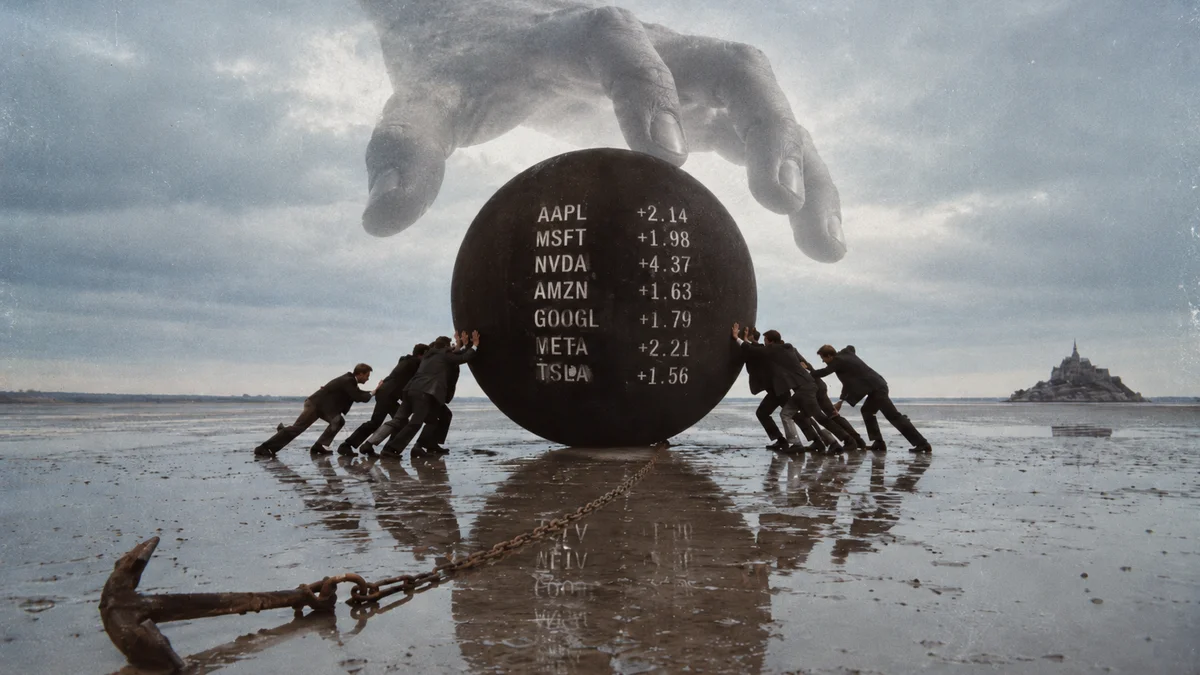
The conventional wisdom now runs roughly as follows. The world has become so complex, so dynamic, so saturated with noise, that direct observation of it is hopeless. The unaided human eye sees only fragments. The way through the fog, therefore, is mathematics—increasingly exotic mathematics—applied to ever larger pools of numerical data. The numbers are taken to be the world; the model is taken to be the territory; and the analyst’s task is to refine the model.
There’s a half-truth here, and it’s the half that’s carried the day. The world is staggeringly complex. Direct observation is inadequate on its own. Mathematics is indispensable. None of that is in dispute.
What’s in dispute is the inversion that has followed: the assumption that mathematics alone can carry the load. That the spreadsheet sees more than the eye. That the territory has become so unreadable that only the map is left to consult. Once the map is treated as the territory, the analyst stops looking out the window. And once the analyst stops looking out the window, the things happening outside the window—the largest things, the slowest things, the things that can’t be modeled because they have no comparable historical referent—become invisible.
Most of those things are, at present, invisible. Not because anyone’s hiding them. Because no one is looking.
The Signal Report proposes restoring the hierarchy. Not replacing the quantitative tools—the tools are excellent—but putting them back where they belong: in service of observation, not in place of it. Mathematics in service of the world, not the other way around. The map in service of the territory.
This isn’t a new idea. It’s the oldest idea in investing.
A Brief History of Seeing
The most powerful investing dynasty in modern history didn’t build its fortune on mathematical models. The Rothschilds built it on intelligence—in the original, pre-digital sense of the word.
In the early nineteenth century, as the Napoleonic Wars reshaped the political and economic landscape of Europe, the five sons of Mayer Amschel Rothschild established banking houses in London, Paris, Frankfurt, Vienna, and Naples. This geographic distribution gave them something no government possessed: a private network of couriers, agents, and encoded dispatches that could transmit real-world information across Europe faster than any state system. Their edge wasn’t philosophy. It was infrastructure for seeing the world more quickly and more accurately than competitors could.
When Wellington defeated Napoleon at Waterloo in 1815, Nathan Rothschild in London is said to have known a full day before the British government’s official dispatch reached Downing Street. The family’s subsequent positioning in British government bonds—buying when uncertainty depressed prices, holding through the confirmed victory—is one of the most famous trades in financial history. The counsel attributed to the family, probably apocryphal, is to buy when there’s blood in the streets. The closest version of the anecdote that survives is set decades later, during the Paris Commune of 1871, where a French investor balks at buying government bonds while the streets are running with blood. The Rothschild reply is essentially a tautology: if the streets were not running with blood, you couldn’t buy them at this price. That’s not bravado. It’s a statement about the relationship between observed reality and price.
A century and a half later, Peter Lynch ran the Fidelity Magellan Fund from 1977 to 1990 and produced an annualized return of roughly twenty-nine percent—a record that hasn’t been matched since. Lynch was a quantitative analyst by training. But the body of work he left behind is essentially an extended argument for direct observation as the primary analytical instrument.
He bought Hanes because his wife Carolyn came home from the supermarket impressed by a new line of pantyhose called L’eggs—not just the quality, but the entirely novel decision to sell department-store-caliber hosiery where women already shopped every week, in distinctive egg-shaped packaging. Lynch looked into the company, liked the fundamentals, and invested. Hanes appreciated roughly thirtyfold. He bought Taco Bell because he ate one of their burritos in California and was struck by it, and was later delighted to find the chain’s executive offices behind a bowling alley—a marker, in Lynch’s view, that the company was spending money on the product rather than on the trappings of corporate ego. He bought Dunkin’ Donuts because he liked the coffee and noticed the Boston locations were perpetually busy. When he visited a shopping mall with his family, he counted bags. He wanted to know which stores were actually generating traffic. “If you stay half-alert,” Lynch wrote, “you can pick the spectacular performers right from your place of business or out of the neighborhood shopping mall, and long before Wall Street discovers them.”
Lynch’s philosophy was that everyday observation gave individual investors an edge over Wall Street professionals precisely because the professionals had enclosed themselves in a world of models and screens. The person walking through the mall could see what the quant staring at a terminal couldn’t.
Warren Buffett built the most successful investment career in modern history on the same foundational principle, refined to its most rigorous expression. Buffett’s approach begins with observation of the real world: the product, the brand, the customer relationship, the competitive dynamics, the quality of management. The mathematics come second. They confirm or deny the observation. They never initiate it.
When Berkshire Hathaway acquired See’s Candies in 1972 for $25 million, it wasn’t because the numbers screamed bargain. Buffett was paying three times book value—a departure from his earlier Benjamin Graham–style discipline. What he and his partner Charlie Munger saw was something the numbers alone couldn’t convey: a brand so deeply embedded in its customers’ emotional lives that the company could raise prices year after year without losing volume. “If you give a box of See’s chocolates to your girlfriend on a first date and she kisses you,” Buffett later told business students, “we own you.” That observation—about customer psychology, about the nature of loyalty, about the real-world experience of buying and giving the product—was the foundation. The mathematics confirmed it. See’s went on to generate over two billion dollars in cumulative pretax profit on an incremental capital investment of just thirty-two million.
The Coca-Cola investment tells the same story at larger scale. Buffett watched the company for years. He understood the product’s universal appeal, the extraordinary global distribution network, the brand’s durability. When Coke stumbled badly with the New Coke launch in 1985, the consumer backlash—which Buffett could observe in real time—actually revealed the depth of the brand’s hold, made visible only because the company had been foolish enough to test it. After the 1987 market crash further depressed the stock, Buffett began accumulating shares in 1988, investing approximately one billion dollars for a 7 percent stake. The mathematics worked because the observation was correct. The observation came first. That initial investment is now worth over twenty billion dollars.
Three different practitioners, three different centuries, three different methods. One epistemological commitment: the world comes first, the model second. The model is in service of the world, not the other way around.
What Has Changed
If the primacy of observation is the oldest idea in investing, why does it need to be restated? Why does it need a newsletter? A book?
Because the environment in which observation occurs has changed—not in degree but in kind.
Nathan Rothschild’s advantage was speed: he received accurate information before others did. Peter Lynch’s advantage was attention: he noticed real-world signals that professionals were too insulated to see. Warren Buffett’s advantage was patience and clarity: he understood what he was looking at and waited for the price to reflect the gap between perception and reality.
All three advantages assumed something about the information environment that’s no longer reliably true: that the signal was there if you looked hard enough. That the real world, observed carefully, would yield accurate intelligence. That the difficulty was on the side of the observer—attention, discipline, analytical skill—not on the side of the signal itself.
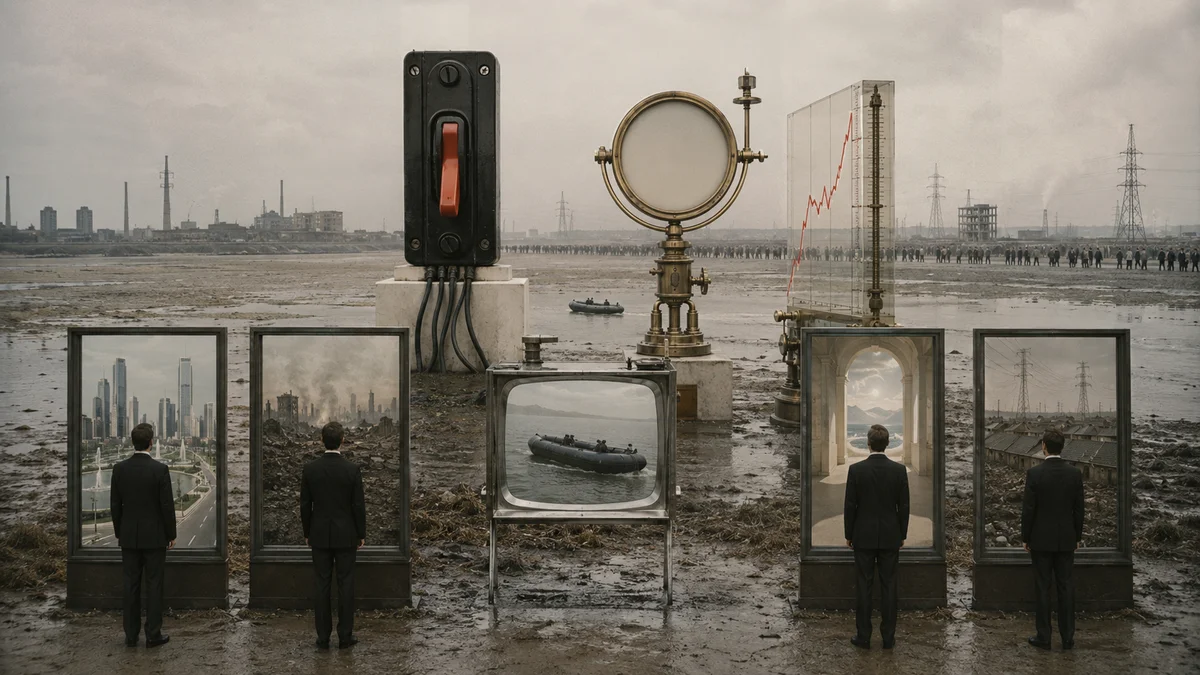
The contemporary information environment is different. The forces now setting the largest prices in the global economy—the prices of stocks, currencies, political outcomes, attention itself—are forces that exceed the resolution of unaided human perception. They’re operating at planetary scale, at machine speed, through opacity that’s sometimes engineered and sometimes simply structural, and through the medium of perception itself. They’re not hidden. Most of them are, at the level of mechanism, fully documented. They’re invisible because the human cognitive apparatus wasn’t built to see them, and because the dominant analytical posture of our moment—the one that mistakes the map for the territory—is structurally configured not to look for them.
Algorithmic amplification. Screen-mediated narrative. The industrialization of attention. The mechanical channeling of capital through passive investment vehicles. Engineered legal opacity. The entanglement of public and private incentive structures at scales that exceed human cognitive resolution. These forces don’t merely make the world noisier. They actively distort the signal. They manufacture consensus that doesn’t correspond to underlying reality. They create systematic perceptual errors that mathematical models not only fail to correct but actively reproduce—because the models are trained on data generated within the same distorted environment.
The map-makers are drawing their maps from other maps. No one is looking at the territory.
The Offer
Every serious investor—whether managing a multi-billion-dollar fund or a personal retirement account—has the same two objectives: see opportunities before others see them, and manage risk that others don’t perceive. Both depend on the same underlying capacity: the ability to perceive what’s actually happening in the economy, as distinct from what the prevailing narrative says is happening.
This is hard. The prevailing narrative isn’t delivered by a single unreliable narrator you can learn to distrust. It’s the accumulated output of an entire infrastructure—media, algorithms, institutional incentives, social proof, cognitive biases, and the sheer complexity of a globally interconnected economy with eight billion participants. It saturates your information environment. It’s the turbid water you swim in. And because it operates through your own perceptual apparatus—through the screens you look at, the feeds you scroll, the analysis you read—you can’t simply decide to see through it. The distortion isn’t a veil you can lift. It’s the lens itself.
The Signal Report provides a different lens.
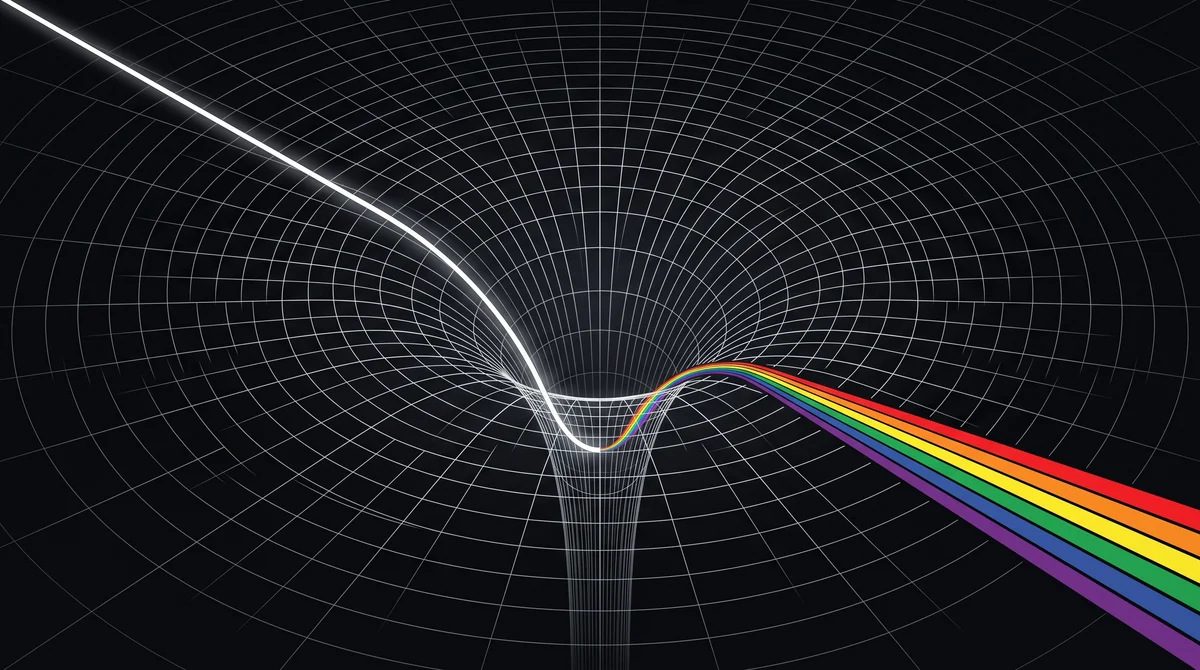
These are what this book calls centers of obscured gravity—large structural forces that exert disproportionate influence on the macro economy relative to the analytical attention they receive. They behave like gravity in the sense that everything in the system bends around them, including the prices. They’re obscured in the sense that the bending isn’t noticed because the gravitational source itself can’t be seen. The investor whose toolkit is purely quantitative is, by construction, looking only at the bent paths. The bending registers as anomaly, as noise, as something to be smoothed by a better model. The thing causing the bending is offstage.
These aren’t conspiracy theories. They’re not predictions. They’re diagnostic observations about forces operating in plain view but below the threshold of conventional perception—invisible not because they’re hidden, but because they exceed the resolution of the instruments being used to look.
The upcoming book provides the framework and the case studies. The newsletter provides the ongoing field reports—specimens examined as they emerge, in the manner of a naturalist’s diary, functioning the way a sonographer applies diagnostic imaging to a living body: not revealing what was concealed, but rendering visible what the unaided eye was never built to see.
What this gives you, if the analysis is sound, is what every investor needs and almost no one has: a structural information advantage. Not faster data. Not better models. Not more sophisticated mathematics. A clearer picture of what’s actually happening.
That’s the arbitrage. Not a trade. Not a tip. An ongoing capacity to see the territory while others navigate by maps.
A Note on Certainty
This preface has made large claims. The book that follows will make larger ones. I want to be direct about the epistemic status of those claims.
I’m not certain I’m right.
I’m certain that the forces this book examines are real, because they’re empirically observable and, in most cases, institutionally documented. I’m reasonably confident that they’re underweighted in conventional analysis, because the structural reasons for their invisibility are themselves identifiable and explicable. I believe the integration of these forces into a coherent analytical framework produces genuine insight—but I hold that belief provisionally, as a working hypothesis subject to revision as evidence accumulates.
What I’m offering isn’t prophecy. It’s a diagnostic instrument. Like any instrument, its value is determined by its accuracy in practice, not by the confidence of its designer.
The Rothschilds didn’t guarantee their intelligence was correct. They built the best network they could and acted on the best information available. Lynch didn’t guarantee that every company he observed in a shopping mall would become a tenbagger. He looked carefully, did his homework, and accepted that he’d be wrong four times out of ten. Buffett didn’t guarantee that Coca-Cola would outperform. He observed, analyzed, waited for the right price, and acknowledged that his estimate of intrinsic value was, in his own words, “a highly subjective figure.”
The Signal Report operates in the same tradition. It looks. It reports what it sees. It provides a framework for making sense of the observation. And it holds its conclusions provisionally, because the forces it examines are dynamic, complex, and resistant to certainty.