The Meme That Evaluates on Your Behalf
Why Every New Imaging Technology Is the Worst Thing That Ever Happened
May 26, 2026A comment arrived under one of my recent videos:
“your content is awesome but honest question: why do you use AI on your videos?”
I want to take this seriously, because the awkward sincerity of it — the compliment, the pivot, the honest question hedge — tells me something useful. The viewer engaged with the arguments. The viewer found them awesome. And then the viewer hit the images and the engagement broke. Something in the visual layer triggered a reflex that overrode everything that came before it.
That reflex -– a reflex I’ve seen triggered across dozens of comments — is the subject of this blog post. It is also, not incidentally, the subject of my entire project: the Julian Whatley YouTube channel, this free blog, and the The Signal Report paid newsletter.
How does a two-syllable phrase shut down visual judgment?
The reflex has a name now. AI slop. Two syllables, doing tremendous work. It functions the way thought-terminating clichés always function — as a license to stop looking. Once the phrase activates, the perceptual apparatus shuts down. Every image rendered through diffusion engines becomes the same image. Quality, intention, craft, semiotic precision — all collapsed into a single dismissive category. The viewer is no longer evaluating; the meme is evaluating on the viewer's behalf.
This isn't a trivial cognitive event. It's a textbook case of what happens when discrimination — the actual mental work of looking, weighing, distinguishing — gets outsourced to a phrase. And it happens to people who pride themselves on being skeptical, on seeing through marketing, on not being taken in. The irony writes itself: the viewer who suspects manipulation everywhere has been manipulated into a position by a meme so efficient they didn't notice it move into the house.
I'm not unsympathetic. There is, in fact, a great deal of bad imagery being produced through these tools. Most of it is bad. Almost all of it is bad. That’s been true of every imaging technology ever invented.
Does using diffusion tools require any craft?
The two men in suits are standing on a Hollywood backlot. The sound stages tower behind them. One of the men is on fire.
That image, produced by Hignosis for Pink Floyd’s 1975 album Wish You Were Here, required traveling to Burbank, casting two stuntmen, lighting one of them on fire, and photographing the result (twelve times!) before he burned. It cost tens of thousands of dollars and took days. Hipgnosis flew to Iceland to make album covers. They built sets. They hired stunt coordinators. They produced, across two decades, perhaps a few hundred images that anyone now remembers.
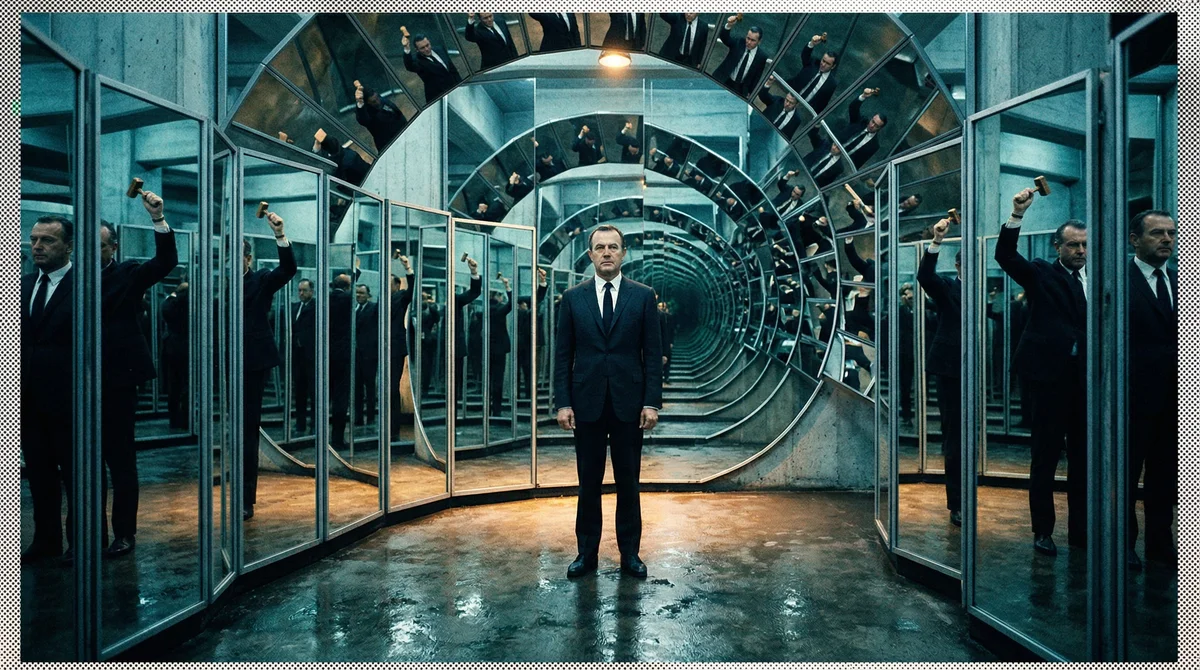
I can produce an image of comparable craft and semiotic density in minutes, for a few dollars, by writing a sufficiently precise prompt and directing three to five diffusion iterations. The image isn't generated. It's directed — the way a cinematographer directs light, the way a production designer directs space. The intelligence in the loop is mine. Forty years of looking at images, making images, getting paid to make images for Fortune 100 brands and music videos and feature films, is what stands behind the prompt. The tool doesn't know what a good image is. I do.
This is what the commenter can’t see, because the meme has already done its work. The commenter sees AI, and the categorical gate slams shut. What the commenter doesn't see is a media metaphysician with four decades of practice, working in an audiovisual medium where the visual layer is doing more communicative work than the spoken word. A talking head isn't a video. A video is sound and image, semiotic density and rhythmic compression, the syntax of visual language operating in parallel with the sentence I'm speaking. I know that lexicon. I’ve been fluent in it since I was a young man.
Is "AI slop" the latest version of an old reflex?
Here’s the historical pattern, which is the part of the answer that ought to be most embarrassing for the people deploying AI slop as if it were analysis.
Photography was the death of painting. Then it wasn't. The Impressionists were charlatans degrading the noble tradition of academic art. Then they weren't. Cubism was nonsense. Talking pictures would destroy the purity of cinema. Television would rot the culture. Digital photography was not real photography. Photoshop was cheating. Pro Tools was cheating. Auto-Tune was the end of music. CGI was the end of practical effects. Every single time — every single one — there were two camps. The camp that picked up the new tools and made things with them. And the camp that stood at a distance and pronounced the death of art.
The naysayers have been wrong one hundred percent of the time. Not most of the time. Not usually. Every single time. This isn't a small datum. It's one of the most stable patterns in the cultural history of image-making, and it should make any contemporary critic pause before adding their voice to a chorus that has, without exception, sung the wrong note.
The pattern holds because the naysayers aren't actually evaluating the tools. They’re evaluating the category of the new — and finding it categorically deficient against the category of the old, which has been retroactively sanctified by the survivor bias of memory. The bad daguerreotypes are forgotten. The bad Impressionist paintings are forgotten. The bad early films, the bad early television, the deluge of bad digital photographs, past and present — all forgotten. Only the work that survived survives, and it survives because somebody at the time looked at the new tool with discrimination and made something with it.
I would invite the commenter to do something that will, I suspect, settle this faster than any further argument from me. Open your phone. Scroll through your camera roll. Count, honestly, how many of those photographs would win a prize. Count how many you would mount in a gallery. Count how many you would describe as anything superior to insipid documentation of a moment.
Most images made with any imaging technology are bad. This has always been true. It will always be true. The presence of slop in a category doesn't invalidate the category. It's the precondition of the category.
Why is the term "AI" itself a category error?
Now the part that dissolves the question entirely.
There is no AI.
The phrase artificial intelligence is a marketing term. It was always a marketing term. The systems being referred to are stochastic diffusion engines — statistical models that produce probability distributions over pixels in response to text inputs. They do not think. They do not decide. They do not, on their own initiative, produce anything. They sit, inert, until a human directs them. The directing human supplies the intelligence, the intention, the discrimination, the aesthetic judgment, the iterative refinement (presuming the human has these things to supply). The machine supplies a probabilistic search over a high-dimensional space of pixel arrangements.
This matters because the entire emotional charge of the commenter's question depends on a category error. The objection assumes there is a thing called AI which is generating images — autonomously, agentially, by its own volition — and that I'm pressing a button and accepting whatever this autonomous thing produces. None of that is true. None of it has ever been true. The reason it feels true is because the marketing apparatus selling these tools wants it to feel true, and because the journalists covering these tools have, almost without exception, ceded the conceptual ground without a fight. We’re now in the recursive position where even the critics of these systems reinforce the marketing frame every time they deploy the term AI. The skeptics have been captured.
So the real question — the one that ought to be on the floor — isn't why are you using AI. The real question is: why do you believe there’s such a thing as AI in the first place, and what does the marketing department of OpenAI gain by your belief?
Why does media literacy matter more than ever?
This is what the blog is for.
The mediated landscape — the screens through which most of us now learn most of what we learn about the world — is contaminated. Not occasionally, not at the margins. Structurally. The contamination runs from the relatively benign forms (advertising, public relations, brand storytelling) all the way to the most consequential (state-sponsored disinformation, coordinated influence operations, manufactured consensus). There is no regulatory body remediating this at scale. There is no institutional immune system. The work of discrimination — of looking carefully, of asking who benefits from this framing, of noticing when a phrase is doing more work than it announced — has been pushed entirely onto the individual citizen.
Few citizens are equipped for this work. They were not trained for it. The schools did not teach it, because the schools are downstream of the same screens. The result is a population of intelligent, engaged, well-meaning people whose perceptual apparatus has been quietly subcontracted to whichever meme arrived first.
I spent forty years on the production side of that apparatus. I know the playbooks because I helped write them. The channel exists to share what that vantage looks like — not as ideology, not as polemic, but as a kind of inoculation. A way of seeing. A set of questions you can ask before the meme finishes loading.
The commenter's question is, in this sense, the perfect specimen. A thoughtful viewer, engaged with the arguments, complimentary of the work — and still, when they hit the images, the meme fired faster than the perception. The whole project of the channel is contained in the gap between your content is awesome and why do you use AI.
If you can see the gap, you’re already doing the work.