The Counterfeit Currency You've Been Collecting All Your Life
A Manifesto for 2026: Why Everything You Know About Busyness Is Wrong
January 6, 2026The Man Who Did Nothing
In 1899, a peculiar economist named Thorstein Veblen published a book that changed how we understand wealth. His insight was deceptively simple: the rich didn’t just have money—they performed having money. They played golf on Tuesday afternoons. They took three-hour lunches. They spent summers in Newport doing absolutely nothing of productive value. Veblen called this “conspicuous leisure,” and he argued it was the ultimate status signal of the Gilded Age. To be visibly idle was to announce to the world that you had transcended the grubby necessity of work.
The wealthy of 1899 would have found the modern CEO baffling. Here is a person worth tens of millions of dollars, and yet they answer emails at 5:47 AM. They schedule calls during their children’s soccer games. They describe themselves, with barely concealed pride, as “slammed,” “buried,” or “underwater.” They wear their exhaustion like a Rolex.
Something happened between Veblen’s era and ours. A complete inversion of value. And if we don’t understand what that inversion is—and more importantly, what it’s cost us—we will continue collecting a currency that has no backing. We will continue to be rich in busyness and bankrupt in time.
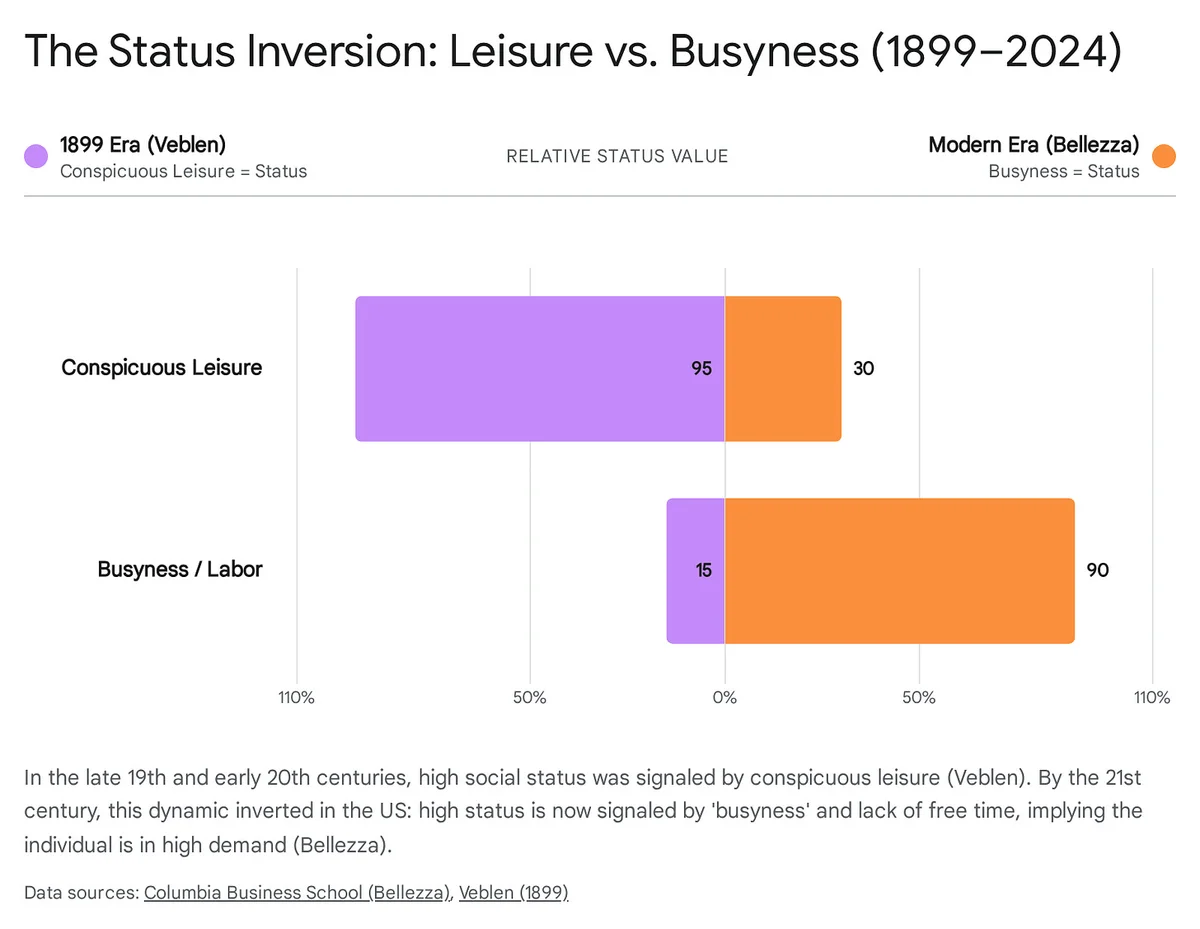
But here’s the question Veblen never anticipated: What if the entire society flipped? What if the thing that once signaled poverty became the thing that signaled worth? And what if, by the time everyone figured out the switch had happened, the new currency had already made us sick?
The Statistical Illusion
Here's a number that should make you angry: according to research by economists Mark Aguiar and Erik Hurst analyzing five decades of time-use surveys, Americans have actually gained four to eight hours of leisure per week since 1965.