The Hidden Forces Holding Up Stocks
The money supply rose sixfold in a working life. Where it went — and why even that number misses most of the dollars.
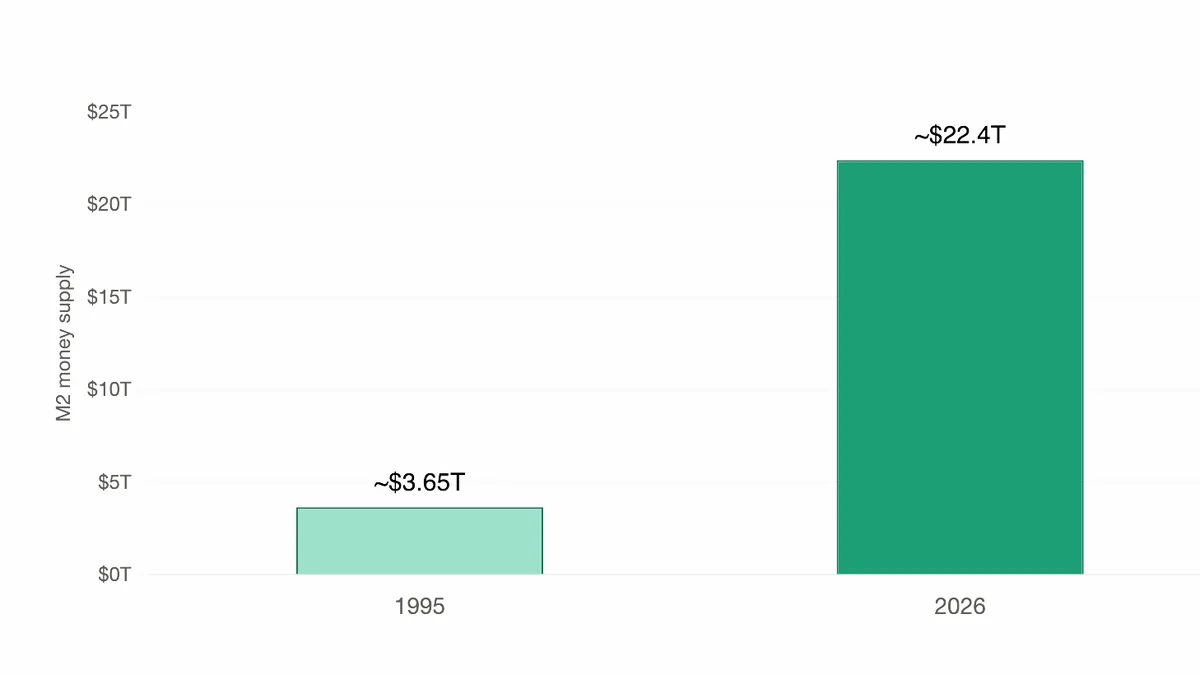
June 22, 2026In thirty years — a single working life — the American money supply has grown to roughly six times its former size: from about three and a half trillion dollars in 1995 to about twenty-two and a half trillion today. That is the sixfold expansion — one quantity, the total stock of dollars, six times larger than it was. This entry asks what that quantity is made of, where the money went once it was clear it hadn't gone into consumer prices, and why even a figure this large counts only the dollars made inside the United States, leaving a comparable mass of them — created beyond its borders — uncounted.
The last entry, Where Do Dollars Come From?, ended with a number and a promise to come back to it. The number was twenty-two trillion. The promise was that it would mean something.
It has a name. The broadest common measure of how much money exists in the country is called M2, and in 1995 it stood at about three and a half trillion dollars. Today it's around twenty-two and a half. Six times larger, inside a single working life.
Most people carry a rough instinct about what that should do to prices. More money chasing the same goods means each good costs more; pour six times as much money into an economy and, the instinct runs, things ought to end up costing something like six times as much. It's close to the oldest idea in monetary economics, and it isn't wrong so much as unfinished. Set it against the evidence and a gap opens: over those same thirty years, the cost of a week's groceries didn't rise sixfold. It didn't come close.