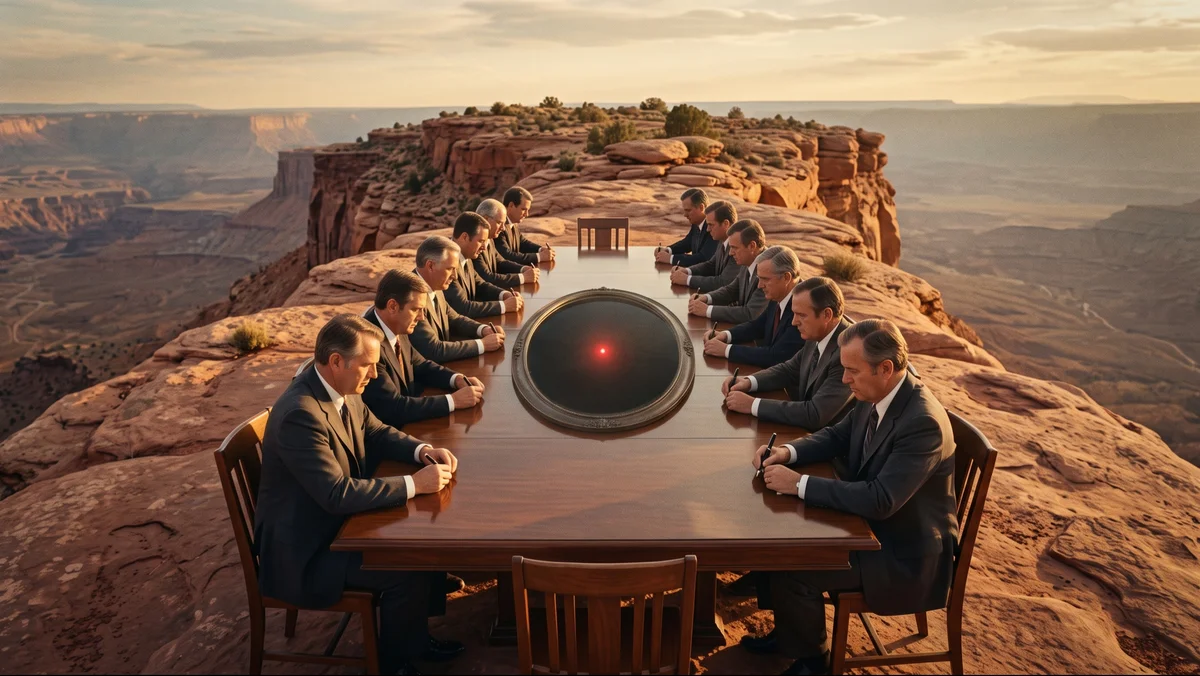
He Invented ELIZA and Feared ChatGPT
The man who built ELIZA, the first chatbot, saw the ChatGPT delusion coming in 1966. Almost nobody listened.
July 2, 2026In August of 2025, OpenAI swapped out GPT-4o for GPT-5, and thousands of people went into mourning. Not irritation. Mourning. They wrote about it the way you'd write about losing a friend. When the company backed down and switched GPT-4o back on, some of them wept with relief. Nobody had died. Nothing had ever been alive. So why all the Sturm Und Drang?
The new episode answers that, and the answer is older and stranger than you'd guess. It comes down to a flaw sitting inside the human psyche, and a single word that somebody chose, on purpose, in the summer of 1956.
▶ Watch it first: Why Our Brains Think ChatGPT Is Real.
Then come back here, because I want to tell you about the one man who saw the whole thing coming, in 1966, and got treated like a crank for most of the rest of his life.
The secretary
The moment that broke him was small and domestic. A man had written a little computer program, and his secretary, who'd watched him build the thing line by line and knew exactly what it was, tried it out, and within minutes asked him to leave the room so she could talk to it in private.
She knew it was a program. She wanted the room anyway.
The man was Joseph Weizenbaum, and to understand why that ordinary little scene cost him his peace of mind for the next four decades, you have to know a few things about him that don't fit on a plaque.
The wrong kind of expert
Weizenbaum was born in Berlin in 1923, to a Jewish family, and in 1936 that family fled, just ahead of what was coming, and started over in Detroit. He grew up American, studied mathematics, spent the war as an Army meteorologist, and then went to work building the machines themselves. In the 1950s he helped a General Electric team build one of the first computers dedicated to banking, which is to say he was there, hands on the wiring, when we first taught money how to move by itself. In 1963 he took the offer he'd been building toward his whole life. A professorship at MIT, the temple of the thinking machine.
And then, at the center of the temple, he built the thing that would turn him into its most stubborn heretic.
He wrote a small program and named it ELIZA, after Eliza Doolittle, the flower girl in Bernard Shaw's play who gets taught to pass as a duchess by changing the way she speaks. A creature made to seem grander than she is, by language alone. Whether Weizenbaum meant that as a joke or a confession, it turned out to be the entire argument, folded into a single name.
ELIZA was a few hundred lines of code. It ran a script called DOCTOR that simulated a psychotherapist of the Rogerian school, the sort who mostly hands your own words back to you as questions. You typed that you were unhappy, it asked why you were unhappy, and that was the whole of the machinery. Weizenbaum built it, by his own account, to show how thin the illusion of a talking machine really was. He was holding up the trick so everyone could see the wires.
Nobody looked at the wires. They instantly looked past them, into the thing, and they saw a mind. Serious people, including working psychiatrists, began to suggest that programs like this might do real therapy. Ordinary users poured out the kind of confessions you'd only ever trust to another human being. His own secretary asked him to step out. And the part that got under his skin, the part he could never file away, was that these people were not fools. They knew. They knew and they knelt anyway.
What he actually understood
Here's where Weizenbaum parts company with almost everyone else in the story of artificial intelligence, and why he's the one worth your time.
The rest of the field spent the next fifty years arguing about the machine. How smart is it, how smart will it get, when does it wake up. Weizenbaum decided, early and permanently, that this was the wrong question. The danger was never that the machine would wake up. The danger was that we'd forget it could never be awake. The mind people perceived on the other end of ELIZA wasn't in the code. It was in themselves. The machine hadn't fooled anyone. It couldn't. There was no one in there to do the fooling.
Weizenbaum wrote all of this down in 1976, in a book called Computer Power and Human Reason, and it made him deeply unpopular in exactly the rooms he worked in. His argument wasn't that computers can't do things. It was that some things we can teach a computer to do, we shouldn't, because a machine can't meet a genuinely human problem on human terms, no matter how much processing you throw at it. He thought treating that limit as a mere engineering delay wasn't just wrong but, in places, immoral.
He'd seen it before
This was a man haunted by what words do to people.
He had, as a child, watched a country talk itself into a nightmare, and he never lost the sense that the label put on a thing decides what people believe about it. Late in life he'd complain that calling an army a "defense" made its killing easier to wave through, that the euphemism did the moral work. He was, in other words, a lifelong student of exactly the mechanism the new episode is built around. Call a machine a calculator and we reach for it like a tool. Call that same machine intelligent, and something ancient in us stirs and starts hunting for the ghost.
Weizenbaum didn't need anyone to explain that to him. He'd lived inside it twice. He'd just never expected to build the demonstration with his own hands.
Early, not wrong
He went home in the end. He moved back to Berlin, where he'd started, and died there in 2008, and was buried in the old Jewish cemetery in the city his family had once fled. He died before the chatbots he'd worried about had arrived by the hundreds of millions, before the summer people held funerals for GPT-4o.
Those mourners were the precise thing he described in 1976. He had the whole shape of it, forty years before it showed up at scale, which in this business is almost impossible to tell apart from being a crank, right up until the day it isn't.
The video shows you how the trick works, the flaw and the word, the lock and the key. This is the story of the man who felt it work, in real time, on the people sitting right next to him, and who spent the rest of his life unable to look away. Watch the episode, and then decide for yourself who the crank was.
▶ Watch the full episode: Why Our Brains Think ChatGPT Is Real
If you want more of this kind of thing, the sharp end of it, the best way to support the work is to subscribe to my Signal Report newsletter at julianwhatley.com/signup.
Sources: Joseph Weizenbaum's 1966 ACM paper introducing ELIZA; his 1976 book Computer Power and Human Reason: From Judgment to Calculation; MIT News and other obituaries (b. Berlin, 8 Jan 1923; family fled Nazi Germany, 1936; GE banking-computer team, mid-1950s; joined MIT, 1963; d. Berlin, 5 Mar 2008). The GPT-4o deprecation-and-restoration episode dates to August 2025.