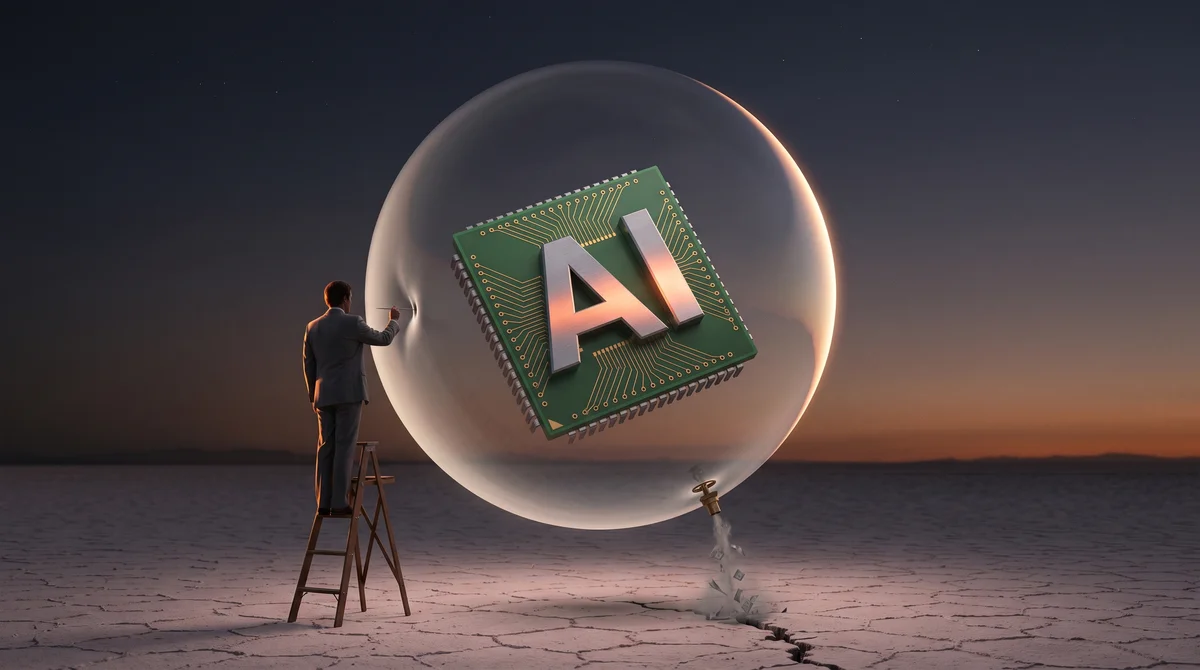
What if the AI bubble bleeds us to death?
What if the AI bubble never pops? The real danger may be a slow bleed through higher bills, private credit risk, and diverted investment.
October 8, 2026I’m becoming less interested in the question everyone else seems to be asking: When does the AI bubble pop? I think the more important question may be: What if it doesn’t have to pop to hurt us?
What if there's no single day when everybody discovers what happened?
What if the costs simply keep spreading outward—quietly enough that each one looks unrelated to the others?
A little more on the electric bill... A little less return in the pension... A little more risk buried inside private credit... A little less venture capital available somewhere else.
No Lehman Brothers... No Black Tuesday... No satisfying moment when somebody rings a bell and announces that the bubble has finally burst.
Just years later, when we add everything up, we realize the money went somewhere. And so did the damage.
The AI boom doesn't have to be worthless to impose costs on people who never chose to finance it. And it doesn't have to end in a spectacular crash for those costs to matter.
That's why I want to follow this story beyond the stock market—into the infrastructure commitments, the electricity bills, the lending arrangements and the things that don’t get financed.
The question isn’t just whether AI investors will get their money back.
It’s how much of ours will be spent finding out.
The money that goes somewhere else
A recent PitchBook report gave me another reason to take this possibility seriously.
Specialist climate-tech venture funds raised $3.9 billion in 2025, down almost 40% from the previous year. Through August 18, 2026, just $546 million had been raised across six funds. For the first time in the report’s dataset, these funds were shrinking both in absolute dollars and as a share of the wider venture-capital market.
The 2026 figure covers only part of the year, and PitchBook cautions that recent fundraising disclosures can lag. These are also specialist funds, not the entirety of investment in climate technology. But within that category, the report identifies a serious contraction.
That doesn't prove AI took the money. PitchBook identifies several other headwinds, including changes to US government support and tax incentives, along with weak exits that leave investors with less capital to reinvest.
But then the report makes a more revealing observation.
AI is also providing a major source of demand for parts of climate technology. Data centers need electricity. That's attracting investment into generation, storage and grid technologies. Some investors are entering clean-energy strategies not because they are pursuing environmental goals, but because they want exposure to the AI buildout. PitchBook warns that this can obscure the broader climate-investment picture: the enthusiasm supports a few areas within a much larger field.
Even inside climate tech, some investment is being reorganized around the requirements of AI.
That's the part that caught my attention.
The usual bubble argument asks whether too much money is being invested in artificial intelligence. I want to ask a second question: what happens to everything else while that money is going in?
What gets financed because it serves the AI buildout? What becomes harder to finance because it doesn’t? And who pays for the electricity, infrastructure and financial commitments being assembled around the expectation that this will all be worth it?
Those questions matter before a single AI company goes bankrupt.
A loss isn't the same thing as a crash
In The Bubble That Couldn’t Pop, my Signal Report post, I developed the other half of this argument: even when investments disappoint, the losses don't necessarily arrive as one unmistakable public event. They can be spread across institutions and across years.
The report’s central proposition was that a crash can be converted into a bleed.
The distinction is between the economic loss and the moment people are forced to recognize it.
Imagine an investment that never earns what its backers expected. That disappointment could become visible through a sudden collapse in its market price. But it could also emerge through years of lower returns, renegotiated commitments and gradual write-downs.
The loss and the event are not the same thing.
My Signal Report post makes a specific forecast about that distinction. Here, I’m interested in something broader—something that matters even if a spectacular crash eventually does happen.
Before asking where the losses land, we need to examine where the resources are going now.
These are two different stages of the same investigation: what the boom costs while it continues, and who absorbs the losses if the returns disappoint.
Neither question is answered by watching Nvidia’s share price.
You don’t have to buy AI to help finance it
Start with electricity.
A Reuters investigation published in May found that millions of Americans are paying toward unfinished power plants and transmission lines. These advance construction charges are spreading amid rising demand, including from AI data centers. Utilities argue that collecting money earlier reduces financing costs; critics argue that it shifts project risk onto customers. The arrangements predate AI, and not every project serves data centers. But they provide an existing route from infrastructure plans to higher bills before construction is complete. Reuters
Consider what that means for the person paying the bill.
You haven't evaluated an AI company’s business model. You haven't decided whether the next generation of models will justify the investment. You haven't bought a share of an AI company.
You have turned on the lights.
The important question is whether the costs associated with a speculative buildout stay with the companies making the commitments—or become obligations for everyone using the electricity system.
That's not an imaginary regulatory problem. In July 2025, Ohio’s utility commission ordered a special electricity tariff for AEP Ohio’s data-center customers, explicitly intended to protect other customers from the costs of underused infrastructure built for data centers. The resulting terms include reimbursement obligations when a customer cancels or substantially delays a project before its scheduled connection. GovDelivery
That protection matters. It also tells us something about the underlying risk: the rules determine where the bill goes.
This is why I don’t regard the absence of a stock-market crash as reassurance.
A family’s exposure to the AI boom need not begin with an investment decision. It can begin with a utility’s construction plan and a regulator’s decision about who finances it.
The risk doesn’t stay in Silicon Valley
Electricity makes the argument tangible. Private credit makes it harder to see.
Private credit matters to this story because it provides a way for financial stress to become harder to see while it remains a problem.
Private credit is basically lending that happens outside the traditional public bond market. Instead of a company issuing bonds that trade every day at a visible market price, an investment fund can make a loan directly to the company and hold it for years.
There's nothing inherently sinister about that. Private credit can finance companies that banks won’t lend to, and the Financial Stability Board says the market now totals roughly $1.5 trillion to $2 trillion. Pension funds and insurance companies are major investors because these loans can offer higher yields and match their long-term obligations. Financial Stability Board
The problem begins when the borrower gets into trouble.
Imagine a company owes $100 million and is supposed to make a $10 million interest payment this year.
It doesn't have the cash.
In a normal default, that failure becomes visible immediately. The borrower missed the payment. The loan is impaired. Somebody has to admit the investment is worth less than expected.
Private credit can offer another option. The lender can say: don't pay me the $10 million now. Add it to what you owe me.
The company survives another year. The original $100 million loan is now roughly $110 million. That's called payment-in-kind, or PIK. The interest is being paid with more debt instead of cash.
The Financial Stability Board says borrowers with negative cash flow are increasingly using mechanisms such as PIK loans, revolving credit and restructurings for temporary relief—and warns that these tools can also signal deteriorating credit conditions. Financial Stability Board
Nothing has been fixed yet. The borrower has simply been given longer to fix it. Sometimes that works. A fundamentally healthy company hits a rough patch, gets another year, recovers and repays the loan.
But suppose the business itself is the problem.
Suppose the data center doesn't generate the expected revenue. Or the AI company can't produce enough cash to service the debt. Giving it another year doesn't make the economics better.
It can make the hole deeper.
The company that could not afford the interest on $100 million now owes $110 million. If it does the same thing again, the obligation grows again.
The absence of a default can therefore conceal the accumulation of a larger future loss.
That matters because private credit loans usually don't trade continuously on an open market. There isn't necessarily a screen somewhere telling everybody every second what the loan is worth. The fund holding it periodically estimates the value.
And the Financial Stability Board warns that these valuations can involve significant discretion. It specifically notes that managers can have incentives to delay or spread the impact of negative shocks rather than recognize the entire decline immediately. Financial Stability Board
So now imagine the same troubled $100 million loan. The borrower has stopped paying cash interest. The debt has been restructured. The lender has extended the maturity. The loan may still be sitting on the fund's books at something close to its previous value. Nothing has technically exploded. But that doesn't mean nothing has happened. The deterioration has been moved forward in time. That's the peril.
And it gets more serious because the people ultimately supplying much of this money are not necessarily Silicon Valley venture capitalists. They are pension funds. Insurance companies. Banks lending to private-credit funds. And increasingly, individual investors buying private-credit products.
The FSB says private credit is intertwined with all of them. It also warns that leverage can exist at several layers simultaneously—inside the borrowing company, inside the fund, at the private-equity sponsor and among investors financing their own positions. In a period of stress, those layers can amplify losses. Financial Stability Board
Then there's a second problem. What happens if investors decide they want their money back?
The loans themselves can be extremely difficult to sell quickly. Yet a growing number of private-credit funds offer investors periodic opportunities to withdraw money.
That works while relatively few people want out. It becomes much more difficult when everyone becomes nervous at once.
The FSB reported that several private-credit funds received withdrawal requests in early 2026 that exceeded their stated limits—often around 5% of the fund's value per quarter. The funds used those limits to restrict how much investors could withdraw. Financial Stability Board
Again, nothing necessarily crashes. Instead, you discover that the investment you thought you could redeem can't all be redeemed when you want it.
And if a fund eventually has to sell illiquid loans quickly to raise cash, it may have to accept steep discounts. Those sales can reveal that the loans were worth less than the values being carried on the books, forcing further markdowns and encouraging still more investors to ask for their money back.
The Financial Stability Board describes precisely that possible feedback loop: unrecognized losses can lead to redemptions, forced sales can push asset values lower, and falling values can further damage investor confidence. Financial Stability Board
So the danger isn't merely that some obscure private-credit fund loses money. It's the sequence: A weak borrower can't pay. The loan gets extended.
Interest becomes more debt. The apparent default is postponed. The asset may remain valued near its previous level. The underlying problem gets larger. Eventually someone has to recognize the loss. And by then the exposure may be sitting inside a pension portfolio, an insurer, a bank credit line or an investment fund owned by people who never believed they were making a speculative bet on AI.
And if AI infrastructure increasingly depends on this kind of financing, then a disappointing AI investment cycle doesn't necessarily produce one spectacular bankruptcy that tells everybody the boom is over.
It can produce an array of more insidious risks: another maturity extension, another year of unpaid interest added to principal, another asset whose value gets marked down gradually, another pension or insurance portfolio earning less than expected, another investor who discovers that the money can't be withdrawn yet.
That's what a financial bleed looks like. The debt hasn't disappeared. The loss hasn't disappeared. The day when somebody has to admit it has simply been kicked down the road.
And then there's everything that doesn’t get built
The most difficult cost to establish may be the one that leaves nothing to photograph.
Imagine a promising biotechnology company that can't raise its next round. A climate fund that never closes. A different industrial project that can't secure the financing or electrical connection it needs on workable terms.
Those examples are questions for this investigation, not losses the PitchBook report has proved were caused by AI. But they identify the missing side of the ledger.
We can photograph a data center. We can report the value of a financing deal. We can count the equipment being ordered. It's much harder to show the alternative that never happened.
The technical term is opportunity cost: what you give up by choosing one use of a resource instead of another.
That doesn't mean there's a fixed bucket of money and every dollar invested in AI is stolen from something more deserving. An investment boom can attract additional capital and expand productive capacity. And some of the alternatives might have been worse investments.
The question is what happens where constraints actually bind.
Suppose a transformer is available for one project but not another. Suppose an investor can back one more fund. Suppose a construction company’s skilled crews are already committed. In each case, choosing one project changes the possibilities for the others.
My hypothesis is that the AI buildout is becoming large enough for those choices to matter well beyond the technology industry.
The climate report doesn't settle that hypothesis. It gives us a place to begin: a field in which fundraising is contracting while part of the surviving enthusiasm is being redirected toward supplying AI’s needs.
Growth for whom?
There's an obvious objection to all this.
Building things is economic activity. A data center under construction employs people and buys materials and services. Domestic investment contributes to GDP, which measures production—not whether every investment will ultimately earn an adequate return. Bureau of Economic Analysis
And AI might deliver substantial benefits. Better tools, more productive businesses and useful infrastructure could justify a great deal of spending.
I’m not arguing that every AI investment is a mistake. Nor does a report on climate fundraising establish that AI’s total effect on the economy is negative.
But “this contributes to GDP” doesn't answer “who benefits, who pays, and what was displaced?” The OECD makes the broader distinction plainly: measuring economic output doesn't, by itself, tell us whether life is improving or for whom. OECD
A boom can produce valuable things and still distribute its costs unfairly.
It can generate strong returns for one group while exposing another to risks it did not understand. It can be worth doing without every financing arrangement surrounding it being worth accepting.
That's the distinction I want to keep in view. The argument isn't “AI has no economic value.” It's that AI’s potential value doesn't settle how much of the rest of the economy should be committed to realizing it—or who should carry the downside.
How much of our future are we reorganizing before we know the answer? And what commitments remain if the answer disappoints?
A subsequent stock-market correction can't retroactively restore the years during which an alternative project went unfunded. It can't make a bill already paid disappear.
The story tells us where to look
This is where the economics meets the thing I spend much of my time examining: the stories that organize our attention.
“Bubble” is a particularly powerful one.
It gives the story a familiar shape. Enthusiasm becomes excess. Skeptics issue warnings. Reality intervenes. The bubble bursts.
Once that ending is in your head, every new development becomes evidence about whether the climactic scene is getting closer. I think that expectation can also direct attention away from the less dramatic questions.
Who signed the contract? Who financed the construction? Who is obligated to pay if the projected demand never arrives? What else became harder to fund?
None of those questions requires a stock-market collapse to become important.
I originally thought of this as a slow-motion tsunami: not simply an overpriced asset waiting to collapse, but a movement of money and resources large enough to displace things throughout the economy.
The more useful distinction, though, isn't whether “bubble” or “tsunami” wins the metaphor contest.
It's whether we’re looking only for an event, or following a process already underway.
The climate report documents a contraction and a redirection of investment. Electricity policy shows how the cost of future infrastructure can reach present-day customers. Financing arrangements show how AI exposure extends beyond the companies whose names appear in