The Word That Made the Machine Seem Alive
When AI gains a startling new skill, is intelligence emerging—or is “emergence” simply the industry’s most persuasive sales pitch?
August 17, 2026In 2022, researchers published a graph that appeared to capture the moment something awakened inside a machine.
A language model containing six billion parameters was asked to add two three-digit numbers. It succeeded about one percent of the time. A model with thirteen billion parameters reached eight percent. Then researchers tested a model with 175 billion parameters. Its accuracy jumped to 80 percent.
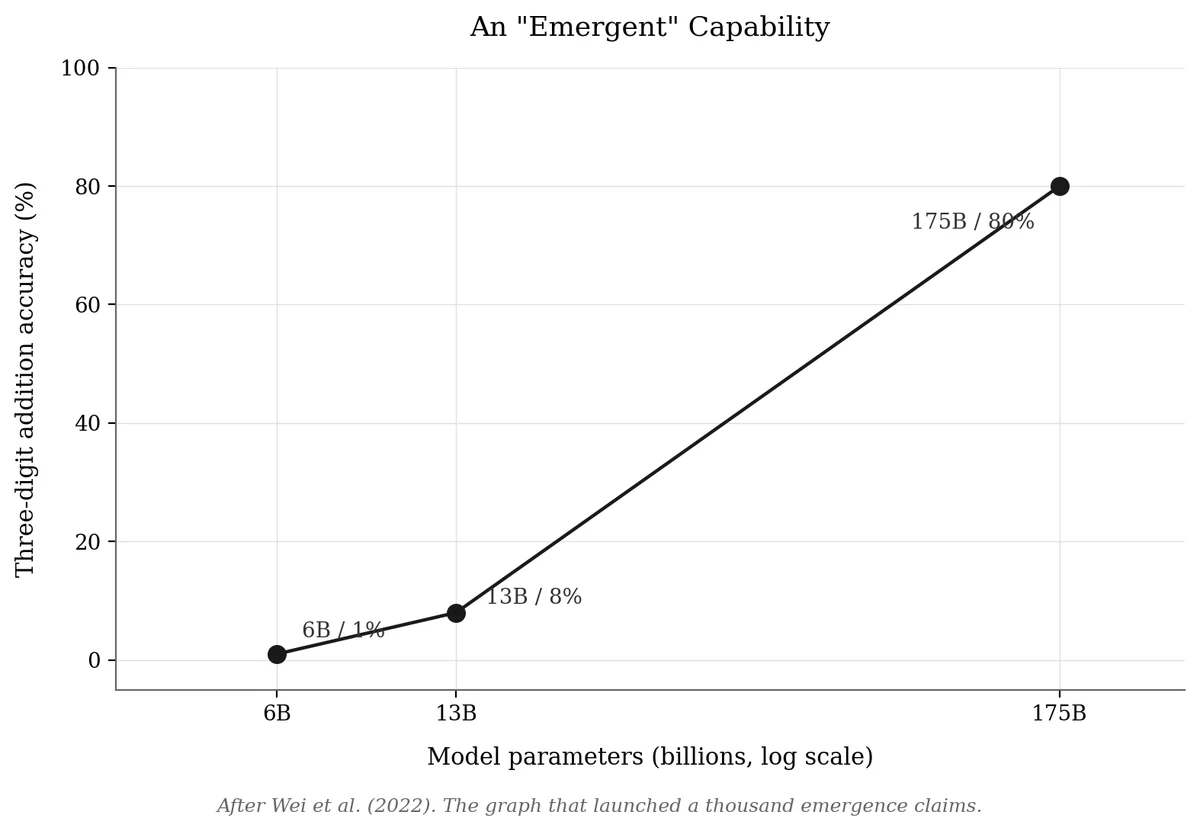
The graph looked like a phase transition—the computational equivalent of water becoming steam. Quantity had apparently transformed into quality. An ability that barely existed in the smaller models had suddenly appeared in the larger one.
Researchers called the phenomenon “emergence.”
It was a scientifically respectable word. It came from physics, biology and complexity science. It was also an irresistible word. Emergence suggested that the machine had done more than improve. Something unexpected had formed inside it—something its creators had not explicitly placed there.
But what if the most important thing to emerge was not a new capability inside the machine? What if it was a new way of talking about the machine?
What if “emergence” belongs to that special category of technological language that simultaneously describes a scientific possibility and markets a speculative future?
What Exactly Emerged?
The original evidence appeared straightforward.
As language models became larger, they sometimes displayed abilities that smaller models lacked. They could solve arithmetic problems, write computer code, answer legal questions and perform analogies. Some of these improvements seemed to arrive abruptly and had not been predicted by conventional scaling laws.
This was presented as evidence that large language models could acquire “emergent abilities.”
But there was a problem: the apparent leap sometimes depended on how researchers measured it.
Imagine measuring a child’s ability to shoot basketballs but recording only whether each shot passes through the hoop. The child’s coordination may improve gradually for months while the official score remains at zero. When the first ball finally drops through the net, the graph records a sudden breakthrough.
Many benchmarks treat an answer as either correct or incorrect. A model receives no credit for approaching the solution. Change the measurement and some emergent abilities become continuous improvements. The cliff becomes a slope.
Other apparent breakthroughs can be explained by instruction tuning or improved in-context learning. Larger models become better at recognizing what a prompt is asking and using examples included in it. That is an important capability, but it's not necessarily a mysterious new organization arising inside the machine.
Something real has happened. The model’s performance has improved. But the word “emergence” quietly shifts the claim. It moves us from observing that the machine produced a new result to imagining that the machine acquired a new internal property.
If surprise is not sufficient evidence of emergence, what would be?
When Does More Become Different?
Imagine describing a river by tracking every molecule of water.
In principle, it could be done. We could calculate the position, velocity and interaction of each particle. In practice, the description would become larger and more complicated than the river itself.
So we use different concepts: pressure, temperature, turbulence and flow. These variables discard almost all the microscopic detail while preserving enough information to predict what the river will do.
That is emergence in its scientifically useful sense.
A large collection of interacting components produces a higher-level organization that can be understood using a smaller set of variables. The new description doesn't merely summarize the system. It gives us predictive and causal leverage over it.
The physicist Philip Anderson captured the idea in the phrase “more is different.” When enough components interact, the system can cease to be intelligible in the language of its individual parts. A liquid is not simply an inventory of molecules. An economy is not simply a list of purchases. A flock is not simply a collection of birds.
Emergence matters because complexity produces compression.
By this standard, a sudden improvement on an AI benchmark is not enough. Researchers would need to show that the model developed some new internal organization: a compressed representation, a reusable abstraction or an effective theory that allows it to solve problems without tracking every lower-level detail.
A performance graph shows what came out of the machine. Emergence is a claim about what happened inside it.
Why, then, has the weaker claim so easily inherited the language of the stronger one?
What Does the Word Allow Us to Imagine?
Words such as “temperature” and “velocity” are useful partly because they reduce ambiguity. “Emergence” works differently in AI discourse. Its ambiguity is part of its power.
In complexity science, emergence describes the appearance of a higher-level organization that makes a system more efficiently understandable. In much of the language-model literature, it describes an ability that appears unexpectedly or abruptly. In public discussion, it suggests something more dramatic: that a machine has spontaneously developed a capacity resembling intelligence.
Those three meanings are related, but they’re not equivalent.
The ambiguity creates a kind of semantic arbitrage. A company or researcher can make a defensible claim using the narrowest definition while benefiting from the excitement generated by the broadest one.
“An unexpected capability appeared at scale” becomes “the model developed an emergent ability.” That becomes “intelligence emerges as models grow.” Eventually, a limited observation about benchmark performance supports a story about the possible birth of a superhuman mind.
No individual step must contain an intentional lie. The transformation can occur through a sequence of modest exaggerations, suggestive headlines and unresolved assumptions. Researchers use a fashionable technical term. Communications departments emphasize its most dramatic implications. Journalists translate it into ordinary language. Investors interpret it as evidence that continued scaling will eventually produce general intelligence.
Uncertainty travels through the system, becoming more valuable at every stage.
This is not necessarily a conspiracy. It’s an incentive structure. The AI industry doesn't require every participant to deceive the public. It merely rewards participants for failing to resolve ambiguities that work in their favor.
But why is the ambiguity so commercially productive?
How Does Ignorance Become Evidence?
There’s an unusual rhetorical reversal hidden inside emergence claims.
Ordinarily, when scientists can't explain how a system produced a result, they say the mechanism remains unknown. In AI discourse, that absence of explanation can become part of the evidence that something extraordinary has occurred.
The developers did not explicitly program the model to perform the task. They can't completely explain how the model performs it. Therefore, the capability must have emerged.
But ignorance about a mechanism doesn't tell us what that mechanism is. A magician becomes more impressive when we can't see the trick, but our failure to detect the method is not proof of supernatural powers.
“Emergence” converts an explanatory deficit into an ontological suggestion. We don't know how the machine did it, so we begin talking as though the machine acquired understanding.
This is especially consequential because the models are famously difficult to interpret. They contain billions of parameters whose interactions are distributed across vast computational structures. Their opacity creates a verification vacuum between observable performance and claims about internal capacities.
The word “emergence” fills that vacuum.
It also gives scaling a direction. If unexpected capabilities emerge when models become larger, then continued scaling appears to promise further emergence. More data centers, more chips and more capital are no longer merely an engineering strategy. They become a path toward increasingly general intelligence.
A scientific uncertainty has been converted into an investment thesis.
Yet this story leaves out something enormous: where the model’s apparent abilities came from in the first place.
Inside the Rube Goldberg Machine
In 2025, an interpretability study from Anthropic offered a rare glimpse into the mechanical labyrinth of a large language model. Researchers sought to map the internal logic that governs how these systems solve problems. What they discovered was a landscape of overwhelming complexity, where even the most elementary tasks triggered a cascade of interactions across a vast causal graph. It was the computational equivalent of a Rube Goldberg contraption—a bewildering architecture of interconnected parts laboring to produce an answer that a child could provide instinctively.
This architectural density stands in stark contrast to the efficiency of human cognition. When a child calculates a simple sum, she is not navigating a network of thousands of specialized nodes. Instead, she possesses a compact and portable concept of arithmetic. Her understanding is built on a reusable representation that allows her to extrapolate to new operations, like subtraction, without exhaustive retraining. In biological systems, intelligence is characterized by this kind of compression; it is the very thing that makes robust generalization possible.
Whether language models achieve a similar economy remains a subject of intense debate. Some evidence suggests that a transformer trained on Othello moves might develop an internal board representation—a genuine world model. Yet other researchers contend that this apparent understanding is merely a collection of thousands of discrete heuristics stitched together, favoring memorization over abstraction. The difficulty lies in the opacity of the machine: from the outside, it is nearly impossible to distinguish between a model that has "gotten it" and one that is simply brute-forcing its way through a repertoire of procedures.
Which returns us to the central ambiguity of the machine.
Is an Astonishing Capability the Same as Intelligence?
A calculator can multiply numbers more accurately than almost any person alive. It can possess superhuman capability without possessing intelligence.
We understand this intuitively because we know how a calculator works. Its operation contains no mystery into which we can project a mind.
Language models are different. Their flexibility and opacity invite projection. They can move from poetry to programming, from medical terminology to jokes. That breadth makes them feel less like calculators and more like thinkers.
But intelligence is not simply the accumulation of capabilities.
A brilliant mathematician is not a warehouse containing thousands of specialized calculators. The mathematician discovers a small number of concepts that illuminate many different problems. Intelligence is demonstrated not only by solving more problems, but by solving them with fewer principles.
Human beings can sometimes reorganize their understanding after hearing a sentence or seeing a diagram. We call this “getting it.” A compressed explanation replaces laborious trial and error. The new concept can then be adapted, communicated and applied elsewhere.
Large language models often operate according to the opposite equation. Their capabilities improve through more parameters, more data, more computation and more energy. They may achieve extraordinary performance, but extraordinary performance doesn't tell us whether they have found an efficient internal theory or assembled a colossal repertoire of procedures.
The distinction can be expressed simply:
Emergent capability concerns what a system becomes able to do.
Emergent intelligence concerns whether it discovers compact, transferable ways of understanding.
The first may already exist in language models. The evidence for the second remains speculative.
So why are the two so frequently allowed to merge?
What Is Emergence Really Selling?
“Emergence” is not merely a word used to describe AI. It's one of the mechanisms through which AI acquires cultural and financial meaning.
The process begins with an observation: a larger model performs unexpectedly well on a task. The observation receives a scientifically prestigious label. The label suggests an internal transformation. That suggestion becomes evidence that scaling produces intelligence. The possibility of future intelligence justifies further investment in scaling. That investment produces larger models, new demonstrations and more claims of emergence.
The story becomes self-reinforcing.
This doesn't mean the technology is fraudulent or that every researcher is intellectually dishonest. The machines possess real and often remarkable capabilities. The problem is that the language surrounding those capabilities consistently pushes interpretation beyond verification.
“Emergence” converts ignorance into mystery, performance into ontology and scale into destiny.
Its scientific meaning remains valuable. If researchers can identify compressed internal representations, genuine phase transitions and abstractions that support robust generalization, emergence may become essential to understanding these systems.
But until that evidence exists, the word tells us at least as much about the AI economy as it does about AI models.
The great promise of scaling is captured by Anderson’s proposition: more is different. Add enough data, parameters and computational power, and something qualitatively new may appear.
But intelligence presents the opposite challenge. Intelligence is the ability to do more with less—to replace an enormous collection of cases with a small number of ideas.
That leaves us with the question hidden inside every claim of emergent AI:
Has the machine discovered a simpler way to understand the world—or have we discovered a more valuable way to describe the machine?