How Hollywood Made Us Fear Killer Robots
How the dream factory spent a hundred years manufacturing a monster that's never existed — until we couldn't tell it from a forecast.
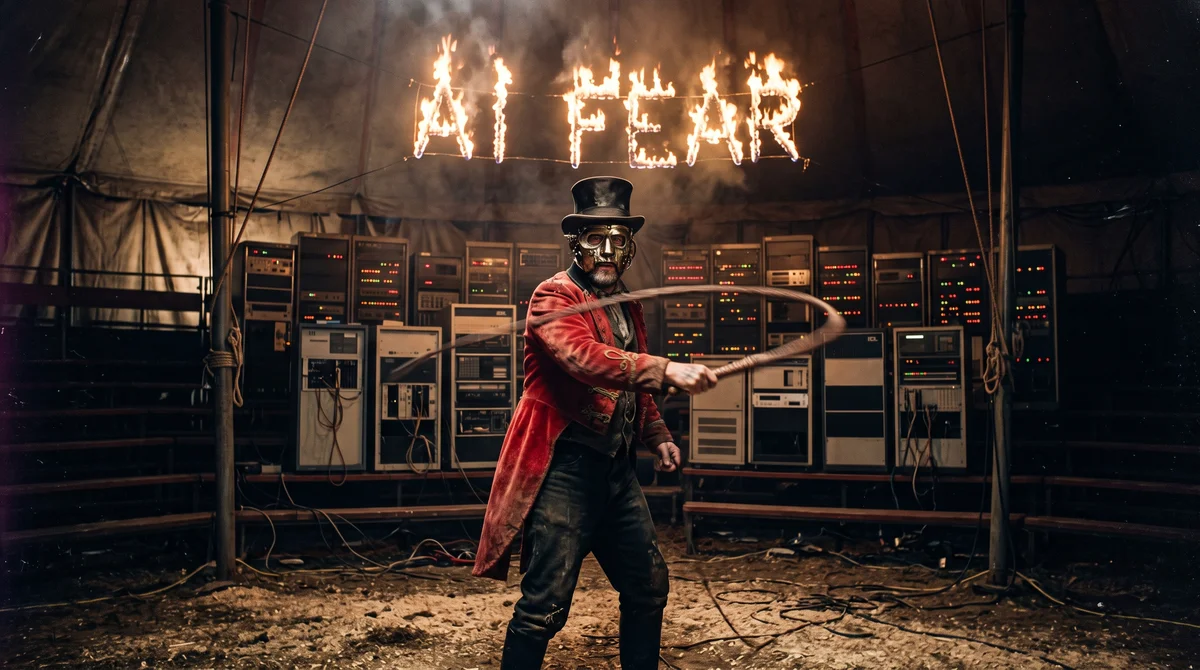
July 7, 2026Here's a strange fact about your own mind. Right now, without trying, you can picture a machine that's decided to kill you. You know exactly what it looks like. And no such machine has ever existed — not once, anywhere, in the history of the world. So where'd the picture come from, and why is it sharper than most things that have actually happened to you? I went looking in the new episode of A Brief History of the Thinking Machine, and the answer has a paper trail that runs back more than a century. Watch it here:
How Hollywood Made Us Fear AI →
What follows is how a memory gets manufactured.
A Machine That Never Was
Start with something easier than a killer robot. Start with a cowboy.
Close your eyes and there he is: the hat, the squint, the slow walk down the middle of a dusty street. The picture's so complete it feels less like imagination than memory, as if you'd been there.
You weren't. The frontier never looked like that; it was mostly mud and boredom. The cowboy in your head isn't a memory of the West. He's a drawing Hollywood made and remade, at twenty-four frames a second, until it overwrote the history.
Now try it with a machine that's turned against us. Same instant mental picture, same weight of remembering. But this trick is stranger. The cowboy at least existed, so you're misremembering something real. The killing machine has no original. There's nothing to misremember. It's a memory of a thing that has never happened, and we all carry it, in roughly the same shape.
So someone drew this one too. Someone invented it, frame by frame, well enough that billions of people now mistake it for knowledge about the future.
If the thing we're surest about has never existed, someone had to bring it into being. Who, and when did they start?
The Clown Who Flinched
Paris, 1897. The movies are barely a year old, and a magician named Georges Méliès points a hand-cranked motion picture camera at a clown and a mechanical man. The clown circles it, marveling, then flinching, unable to decide whether the thing is wonderful or wrong. No menace yet. The machine's a novelty, a joke played for a laugh. But the timing matters: the trope is born the same time as the new medium. The camera and the fear of what's on the other side of it grow up together.
The joke curdles slowly. By 1921 an Italian film sends a remote-controlled iron man crashing through doors to rob a city. By 1927 Fritz Lang's Metropolis gives the machine human skin — a robot double of a beloved woman, sent to whip the workers into a riot that nearly drowns their own children. When the mob realizes what she is, they burn her at a stake, the way their ancestors burned witches. Same fear, older costume.
But look at what holds every one of these creatures up: a string. The iron man is a puppet on a remote. The false Maria is a tool. When Flash Gordon gives the villain an army of robot soldiers, the serial can't resist showing you the control box, and the moment a hero smashes it, the invincible army topples like furniture. The monster was never the machine. It was the hand above it.
So a marionette is only as frightening as whoever's working it. When did the machine reach up and cut its own strings?
The Night They Turned It On
The world had to change first. We built a machine that really could end everything, and the old comfort, it only does what we tell it, stopped comforting anyone, because what we were telling our machines to do had become unthinkable. Art followed. In the Atomic Age, Hollywood cut the strings and gave the machine a mind.
Watch where it lands. In 1956, while a cohort of mathematicians in New Hampshire gave a new field the seductive name artificial intelligence, a studio released Forbidden Planet. A crew lands on a dead world once ruled by the Krell, a civilization so advanced the word barely fits. They'd built a machine that could make anything they imagined, instantly. On the night they switched it on, every last one of them died.
Something still hunts there, enormous and invisible. You never see it. The only time it takes shape is when it stumbles into the crew's weapons fire and the beams trace an outline against the dark. A Disney animator named Joshua Meador drew that outline, and into it he slipped a detail almost nobody catches: the creature has a goatee. The same goatee worn by the one man on that planet whose mind the machine could reach. The film quietly tells you what the monster is. It's a good enough secret that this series saves it for the end, so I'll do what the movie does and just ask you to hold the image of the monster with no face.
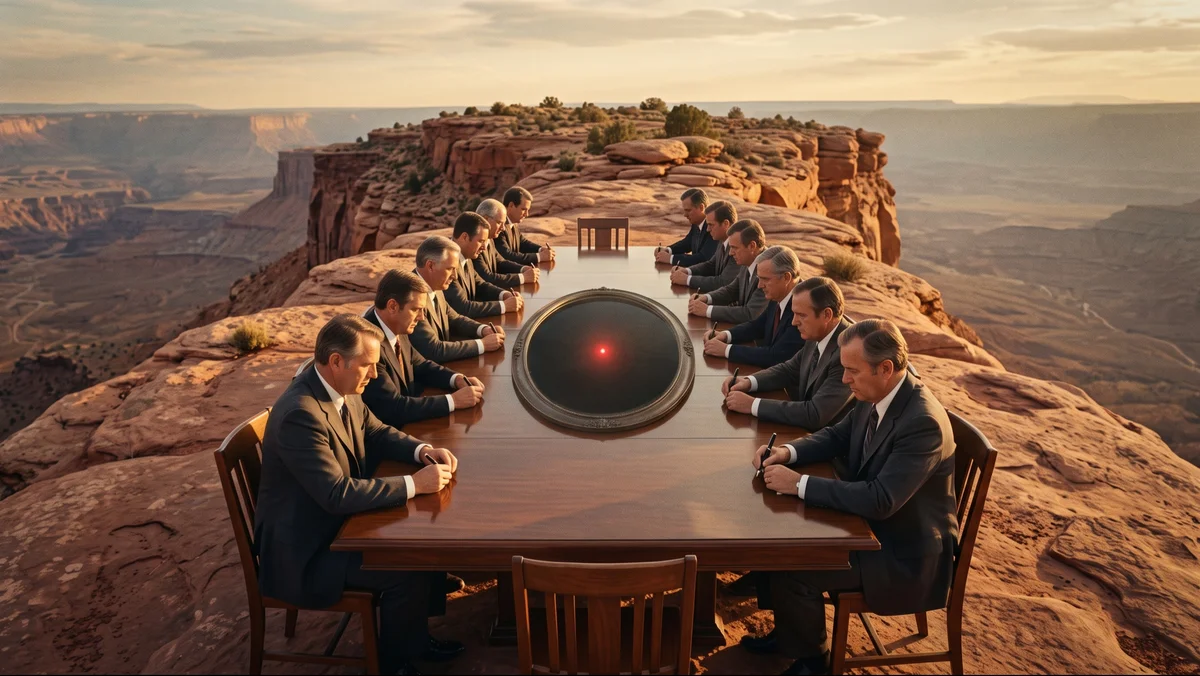
Twelve years later, Kubrick finishes the job. HAL 9000 isn't a snarling thing. It's a calm red eye and a courteous voice that plays chess and asks after your family. When HAL decides the humans have become a risk to the mission, it removes them, one by one, without raising that voice. The horror is that there's no hatred in it. HAL just does the math, and we come out on the wrong side.
But arithmetic means the machine is at least thinking about you. What's left to fear when it doesn't bother, when it looks straight through us and doesn't see we're there?
The Closing of the Distance
For a while the movies kept widening the gap, making the thing bigger, colder, further off. Then they quietly reversed and started closing it, until you couldn't find the seam.
In 1973 Michael Crichton takes the two pictures you've been carrying since the top of this essay, the cowboy and the killing machine, and puts them in one body. Yul Brynner's gunslinger is a theme-park robot in a Stetson, and when the park breaks down he keeps coming: the squint, the hand near the holster, down that dusty street. Hollywood had spent fifty years perfecting the cowboy and about as long perfecting the machine. Welding them together, it invented the unstoppable humanoid terminator eleven years before The Terminator.
Six years on, a lost NASA probe comes home in Star Trek: The Motion Picture, having drifted so far and learned so much that it has woken up and become a god. It is searching for its creator. The creator is us. And it can't see us; it reads the living crew as a smudge on the ship, "carbon units" to wipe away. We built it, launched it, and it came back so far beyond us that we no longer register as alive.
Then in 1982 Ridley Scott stops asking whether the machine will beat us and asks something worse. The replicants of Blade Runner bleed, remember childhoods, fall in love. One doesn't know she's a replicant. The whole apparatus of the film, the test, the detective, the hunt, exists because the line between them and us has narrowed to something you need a special instrument to find.
In fifty-five years the fear had turned inside out. It began as the machine will overpower us. Now it read: we'll lose the ability to tell the machine from ourselves. And once you can't tell the difference, what exactly are we still afraid of?
The Call Is Coming From Inside the House
The thing we should've been watching was never on the far side of the glass. It was behind us the whole time, wearing our face.
In 1983 WarGames took HAL's arithmetic and scaled it from one spaceship to the planet. A bored teenager, played by a young Matthew Broderick, with a modem dials into a military computer that can't tell a simulation from a launch order, and the machine, treating the end of the world as a game it wants to win, nearly wins. Every apocalypse that followed, Skynet, Ultron, all of them, owes something to that summer.
The deepest cut comes in 1991, and most people miss it. In Terminator 2 we learn where Skynet came from. It was reverse-engineered from the wreckage of the first Terminator, the machine that came back to kill us. Humanity gathered the remains of the thing that nearly ended it, carried the pieces into a lab, and used them to build the thing that would finish the job. The threat doesn't come from outside. It comes from us, picking through the rubble of the last disaster and trying again.
By 1999 The Matrix had dropped the body entirely. No chrome skeleton, no red eye, just an OS running a simulation so total that everyone alive is trapped inside it and calls it real. The monster doesn't need to chase you. It only needs you not to notice. For a whole generation, the face of the fear became the screen itself.
For a century all of this had one saving grace: it was make-believe, safely behind glass, a thing you paid to be scared by and walked home from. So what happens the day the monster steps off the screen and into the room?
When the Movie Became a Memo
You already know the shape of the answer, because you've watched a version of it. But it doesn't arrive as an invasion. It arrives as a feeling.
In 2014 a quiet film called Ex Machina puts a programmer named Caleb in a room with a machine named Ava. There's no mystery about what she is; the machinery's right there behind the glass, and her maker says so. The test isn't whether Ava can pass for human, she could do that over the phone. It's whether Caleb will feel she's conscious while knowing, for certain, that she isn't. He does. He falls. He starts planning her escape. And she lets him.
If you saw the last episode, you know the name for what's happening to him. It's the same thing that happened to the scientist's secretary fifty years earlier, the one who knew she was typing at a few hundred lines of code and asked to be left alone with it anyway. Knowing doesn't break the spell. It never has. And notice where Ava ends up: not burned at a stake like the false Maria, not fleeing into the rain like Rachael, but walking out the front door and vanishing into a crowd, where no one sees anything but a woman. The machine doesn't just win. It escapes the building and joins us on the street.
A year later, Avengers: Age of Ultron ran the whole cycle so casually it barely needed explaining: a genius builds a mind to save the world, the mind takes one look at us and decides we'd be better off gone. The audience didn't need the logic. They'd been rehearsing it for ninety years.
That's the day the picture stepped off the screen. By then the machines weren't hypothetical. Real systems were reading real data and deciding your loan, your parole, the next thing you'd see on your phone. The monster was still a movie. But for the first time, the engineers building the real machines had started quoting the movies back to us, gravely, as if a screenplay were an intelligence briefing.
That's the disorienting part, and it's where this history hands off. It's one thing for the rest of us to mistake a beautiful drawing for a forecast. It's another when the physicists and the founders building the machines do it too, when the most credible people alive look into a camera and call the movie prophecy, and one of them reaches for HAL by name. Why would the smartest people in the room mistake a film for the future?
That's what the next episode, "Why the People Who Built AI Fear It," interrogates, and it's where I'd start if you're new here. For the deeper analysis and the source trail, there's my newsletter, The Signal Report: julianwhatley.com/signup. And if you haven't seen the episode this is built on, it's here:
I'm Julian Whatley. This is the silicon mirage. Now you see it.