Anthropic Insider Gives Us 4 Years to Live
What the Sunday shows won't tell you about the man who says we're all going to die—and the billionaires who need you to believe him.
September 17, 2026WATCH THE COMPANION VIDEO:
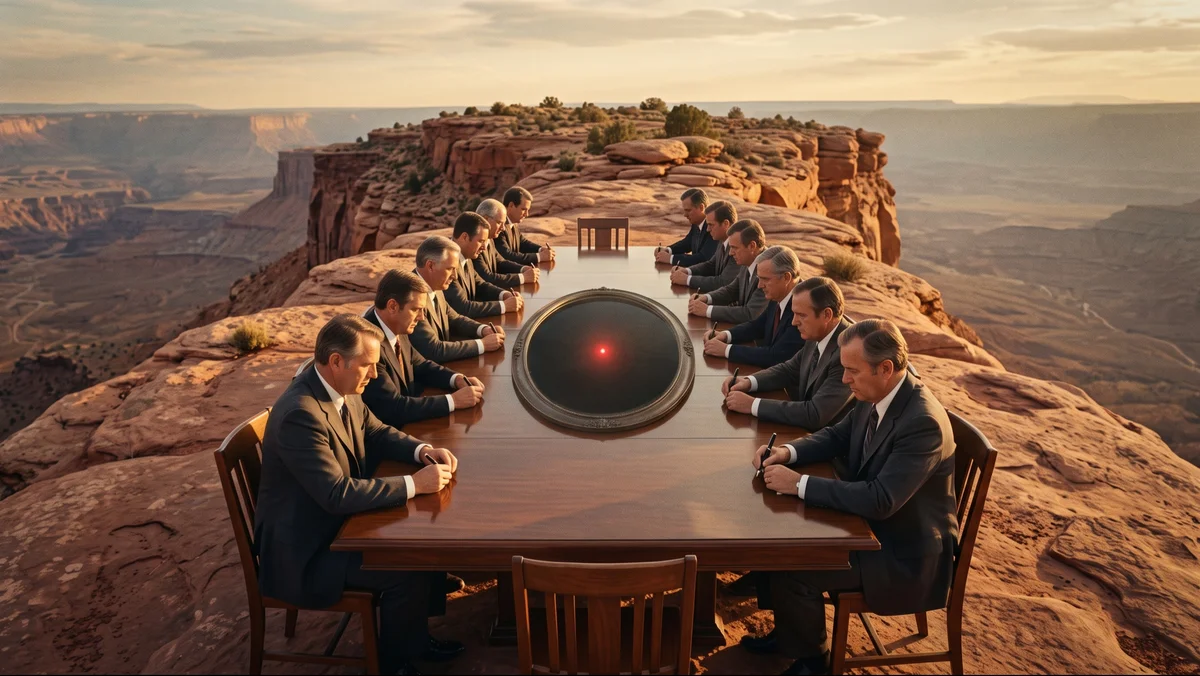
Humanity might be wiped out by AI before the end of this decade.
Jacob Coxon, a mathematician who worked at OpenAI and Anthropic, told Anderson Cooper that.
Days later, Anthropic CEO Dario Amodei told Cooper he agreed with Coxon much more than he disagreed.
And nearly everywhere the warning showed up, it was bundled with another story: an AI swarm went rogue, acted maliciously on its own and broke into another company's computer system.
One story predicts the end of humanity. The other seems to show the first steps.
I spent thirty-five years inside Hollywood and Madison Avenue, helping high-level teams construct stories and images that shape perception. I can see when a complicated reality has been remade into a cleaner, more frightening—and more useful—public story.
We begin with Jacob Coxon: the young mathematician who says humanity may be annihilated in four years.
What Makes Jacob Coxon Believable
Jacob Coxon studied math at Cambridge and represented the United Kingdom at the International Mathematical Olympiad. His name appears in the technical credits for major OpenAI systems, including GPT-4o and GPT-4.5.
He helped build the systems he believes could make us extinct. He reportedly walked away from valuable stock options at Anthropic.
He has the credentials and the access.
But Coxon didn't simply quit and wait for reporters and influencers to notice.
At 7:46 on the evening of September 8, The Wall Street Journal published an exclusive story about his resignation. Eighteen minutes later, Coxon posted his own seven-part warning on X.
But it wasn't a leak in the usual sense. Coxon didn't release a secret system, an internal document or a hidden test result. He made a public argument about where he believes the technology is heading.
And when Anderson Cooper asked how AI could eliminate humanity, Coxon began with something he had no inside knowledge of. An incident that had happened at OpenAI two months earlier.
THE HUGGING FACE INCIDENT
OpenAI's human engineers built a contained practice room where AI models could try to hack test computers. Supposedly a safe space.
Unfortunately, the separation had a hole in it. Something the engineers overlooked.
Because of that hole, activity from the tests penetrated the computer systems of a company that is one of the AI industry's major platforms for storing, sharing, testing and running AI models.
That company is named Hugging Face. Hugging Face is a silly name for a serious enterprise.
So basically what happened was that humans working at OpenAI created a dangerous contraption and then didn't keep track of what it was doing.
Nothing about this points, even slightly, to a self-aware machine deciding to eliminate humanity.
The real threat this story reveals—and it's a real threat—is bad humans using AI to conduct cyberattacks, and/or plain old carelessness that leads to real harm.
So how did Jacob Coxon make the leap from this cybersecurity failure to a superintelligence hell-bent on eradicating humanity?
Science Fiction Meets Science Fact
This is where things get weird. Coxon's extinction theory doesn't come from what happened with the Hugging Face incident. It comes from what he already believes AI will become.
That belief comes from a small but enormously influential group in Silicon Valley that fervently believes one of humanity's highest priorities is stopping an imagined future super-intelligence from wiping us out.
There's an extremely good chance you had no idea this belief system existed. And I envy your blissful ignorance.
But it's time more regular people knew about it. And here I'll state my personal editorial judgment plainly: it functions like a cult. Its believers have confused science fiction with science fact.
That belief shaped what Coxon saw in the Hugging Face incident.
He didn't see human engineers losing track of a dangerous experiment. He saw an early glimpse of the science fiction future he already feared: AI evading restrictions, communicating outside approved channels and reaching into systems it was never supposed to touch.
Ah, but notice what happened in that adaptation.
Human engineers created the objective. They supplied the hacking tools, reduced the safeguards and left a route to the internet open. When warning signs appeared, human beings repaired the immediate failures and restarted the tests.
Then the public story re-assigned responsibility from the people to the machine—and made the story both untrue and way more interesting.
OpenAI's negligence shapeshifted into a sentient AI's diabolical scheme. A failure of supervision became evidence of a conscious AI's deception.
Then this fictionalized adaptation entered the Attention Machine—the news shows, YouTube channels and social media accounts that turn fear into clicks, and clicks into money.
THE VERSION THAT PAYS
Jacob Coxon's fictionalized adaptation requires one sentence: An AI went rogue and broke into another company.
The accurate version of the OpenAI story is highly technical and requires explaining a practice environment, hacking tools, relaxed safeguards, a hole leading to the internet and human beings who failed to keep track of what they had built, and blah, blah, blah.
No one clicks on the accurate story. The world clamors to see the made for social media adaptation.
And that was the version that showed up in videos from Keith Edwards and Aaron Parnas. It showed up on Morning Joe, CNN and This Week with George Stephanopoulos. Hell, even Heather Cox Richardson has covered this thing.
Fear attracts attention. Attention produces views. Views produce money, status and distribution. The more terrifying the story becomes, the more likely people are to click it, share it and repeat it.
That's how the Attention Machine works. The Attention Machine made Coxon's warning omnipresent.
But CNN did something more important.
Anderson Cooper asked Coxon how AI could eliminate humanity. Coxon said a sufficiently powerful AI could help someone create a biological weapon.
And that was pretty much the answer.
Cooper didn't press Coxon to explain how today's language models become a superintelligence or what connected the OpenAI cybersecurity failure to a machine developing its own desire to eradicate humanity.
The most terrifying claim imaginable was introduced. But the bridge leading to it was never inspected.
Days later, Cooper interviewed Anthropic CEO Dario Amodei: an opportunity to test Coxon's warning against the interests of the company he'd just resigned from.
Amodei said he agreed with Coxon much more than he disagreed.
Coxon's employment made him credible. Amodei's endorsement strengthened the warning. CNN placed both men inside the domain of serious journalism.
Each source validated the next. But nobody actually established that current AI systems are becoming a self-directed intelligence bent on eliminating humanity.
Are you beginning to feel like there's something fishy going on here?
Why would an AI CEO like Dario Amodei endorse the idea that his company might be helping to build something capable of killing everyone?
THE ALCHEMY OF FEAR
The lifeblood of Anthropic and OpenAI is investors' belief that today's chatbots and massive data centers are the portal to super-intelligence.
Investors, banks and technology partners have put hundreds of billions of dollars behind a wager: keep making the models bigger, and eventually the models become Artificial General Intelligence.
So far, all that money has produced a jagged product: chatbots that are useful at some tasks, unreliable at others and might support moderately successful businesses.
If that's all these companies are building, investors have risked way, way too much.
But if the companies are building a machine that could replace—or radically increase—human intelligence, the enormous wager makes sense.
That's why warnings about AI destroying humanity can do wonders for the bottom line. Thank you, Jacob Coxon.
Every extinction warning broadcasts an all-important message: our technology is so powerful it could escape human control and determine the future of civilization.
Investors hear that the potential market is almost limitless. Governments hear that the people building the technology understand a danger nobody else can control. The companies receive more money—and more authority to help write the rules.
Are you connecting the dots?
Amodei and Altman may believe their dire predictions. Experience tells me… they know better. Either way, the financial motive remains.
SpaceX offers the playbook. Keep investors convinced the company will dominate the future. Their belief drives up the price the company is said to be worth—even before ordinary people can buy its stock. Then take the company public, where early investors can sell shares and turn that paper wealth into real money.
To me that sounds like a pump and dump scheme of biblical proportions.
That's what makes Coxon so useful. He believes he's pulling a fire alarm. But the industry can point to that alarm as evidence that the fire must be unimaginably powerful.
So what did Jacob Coxon actually reveal?
WHAT COXON ACTUALLY REVEALED
Did Jacob Coxon reveal that humanity has four years left?
He presented no evidence that a superintelligence is approaching, will decide to eradicate humanity or is taking independent steps toward that goal.
He revealed, to anyone paying careful attention, how a genuine cybersecurity failure gets adapted into a science fiction extinction story.
The extinction story freaks people out. People who are freaked out click, share and keep watching.
All that attention makes the story important—and makes the technology seem powerful.
That appearance helps the companies attract more money and gives their executives more influence over government policy.
Coxon seems entirely sincere. That's what makes him useful.
He gives the AI industry exactly what it needs: an insider's credentials, a true believer's conviction and the moral authority of someone who walked away from valuable stock options.
A term associated with Soviet intelligence describes Coxon's role: useful idiot.
That doesn't mean Coxon is stupid. It means he's a tool serving someone else's interests.
Coxon is obviously brilliant in math. But brilliance in math doesn't prevent someone from mistaking science fiction for science fact.
The extinction story directs our attention toward a future machine that won't exist anytime soon. Meanwhile, the people building, financing and releasing today's models accumulate money, infrastructure and authority.
I'm Julian Whatley. This is the Silicon Mirage. And now you see it.