Why Expertise Can Drive Audiences Away
The curse of knowledge can make powerful ideas harder to share. Julian Whatley confronts the painful gap between seeing clearly and reaching people.
September 4, 2026If you subscribe to this project, you're subscribing to a method of seeing.
The promise is simple: I'll show you how the version of reality reaching you was produced—and where to look for what the production leaves out.
The subject may be artificial intelligence, a corporate valuation, a data-center announcement, an expert prediction, housing, infrastructure, or institutional power. The subject can change because the underlying investigation does not. I begin with what materially exists. Then I ask who selected the facts, who framed them, who conferred authority, who distributed the resulting picture, who failed to reconcile it against reality—and what became possible once enough people accepted it.
This is what I call the Supply Chain of Perception.
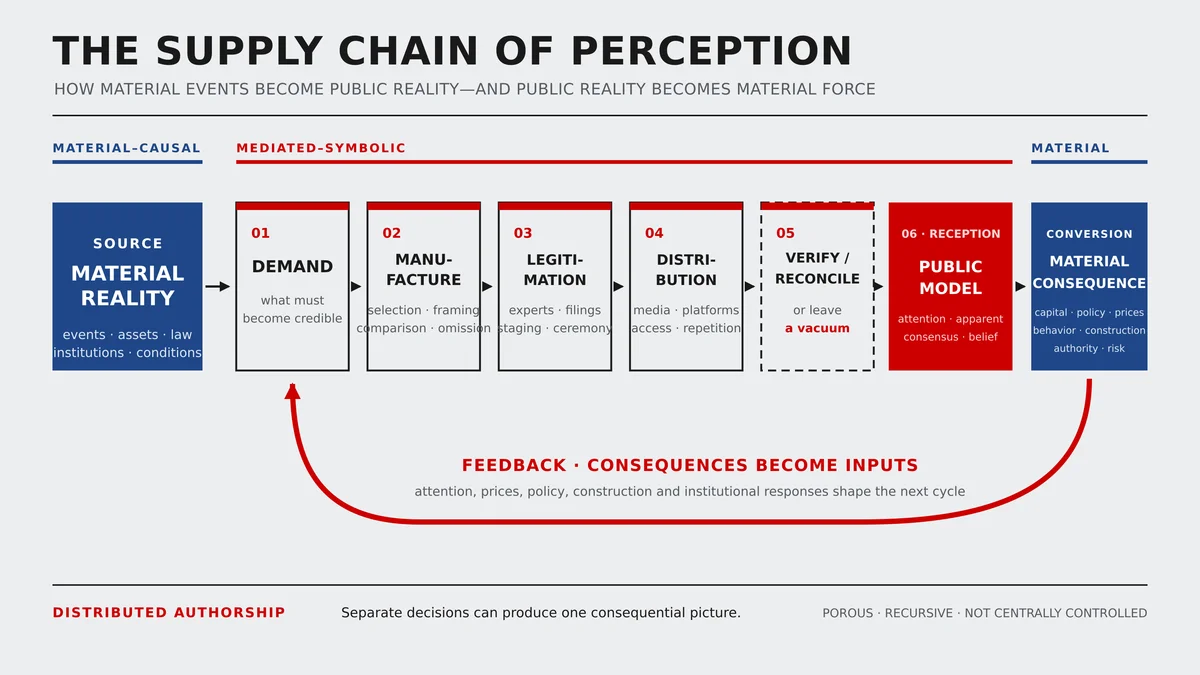
What you get from this project is not merely more information. It's an attempt to recover the structure that ordinary coverage leaves dispersed: the relationship among the facts, the people who made consequential decisions, the incentives shaping the presentation, and the material future the presentation helped create.
That's the promise.
Now I'll tell you what it's cost me to learn how to deliver it.
The numbers on the screen
Two days after I released The Joke That Perfectly Explains AI, I opened YouTube Studio and saw 13,700 views—and an estimated 3,500 unique viewers.
YouTube’s measurements don't all update at the same speed, so the ratio shouldn’t be treated as a precise replay count. But the rest of the dashboard pointed in the same direction. Regular viewers were watching for an average of 11 minutes and 11 seconds. New viewers were leaving after 6 minutes and 5 seconds.
My core audience liked the video. Many loved it. They understood the argument, repeated its central language in the comments, and used it to articulate concerns they’d struggled to name.
I value that audience enormously. They’re not a consolation prize. They are the reason this project exists.
But I had made the video hoping it would reach new viewers.
I’d poured the usual unreasonable amount of myself into the research, the writing, the images, the narration, and the edit. I had imagined strangers encountering the idea, following it, sharing it, and perhaps finding the rest of the work.
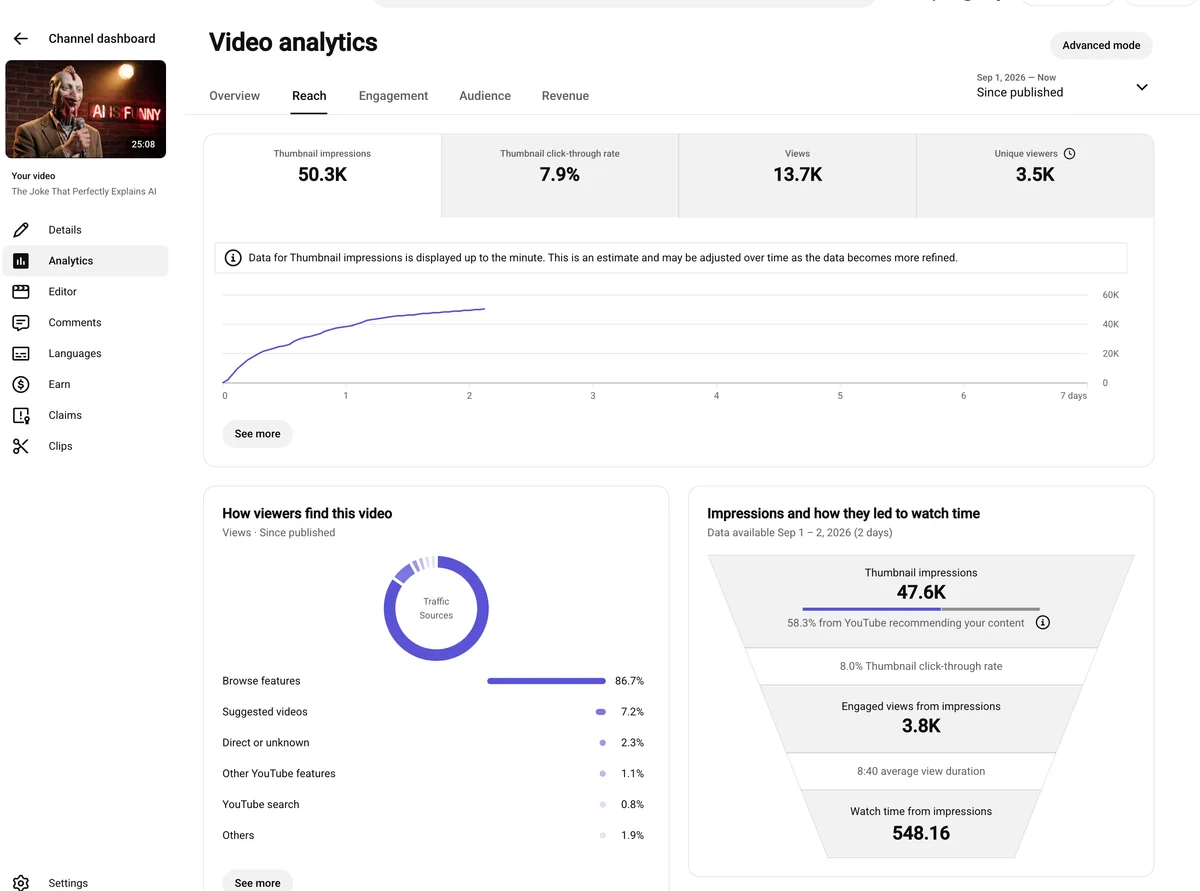
The dashboard did not merely report traffic. It measured the distance between what I’d hoped I made and what I had actually managed to communicate.
That distance is painful.
Anyone who makes things for an audience knows the strange wager involved. You work alone, making hundreds of decisions on behalf of people who’re not in the room. You try to imagine what they know, when they will become curious, when they will feel lost, and what will make the time you're asking from them feel worthwhile.
Then you publish, and the abstraction called “the audience” becomes a retention curve.
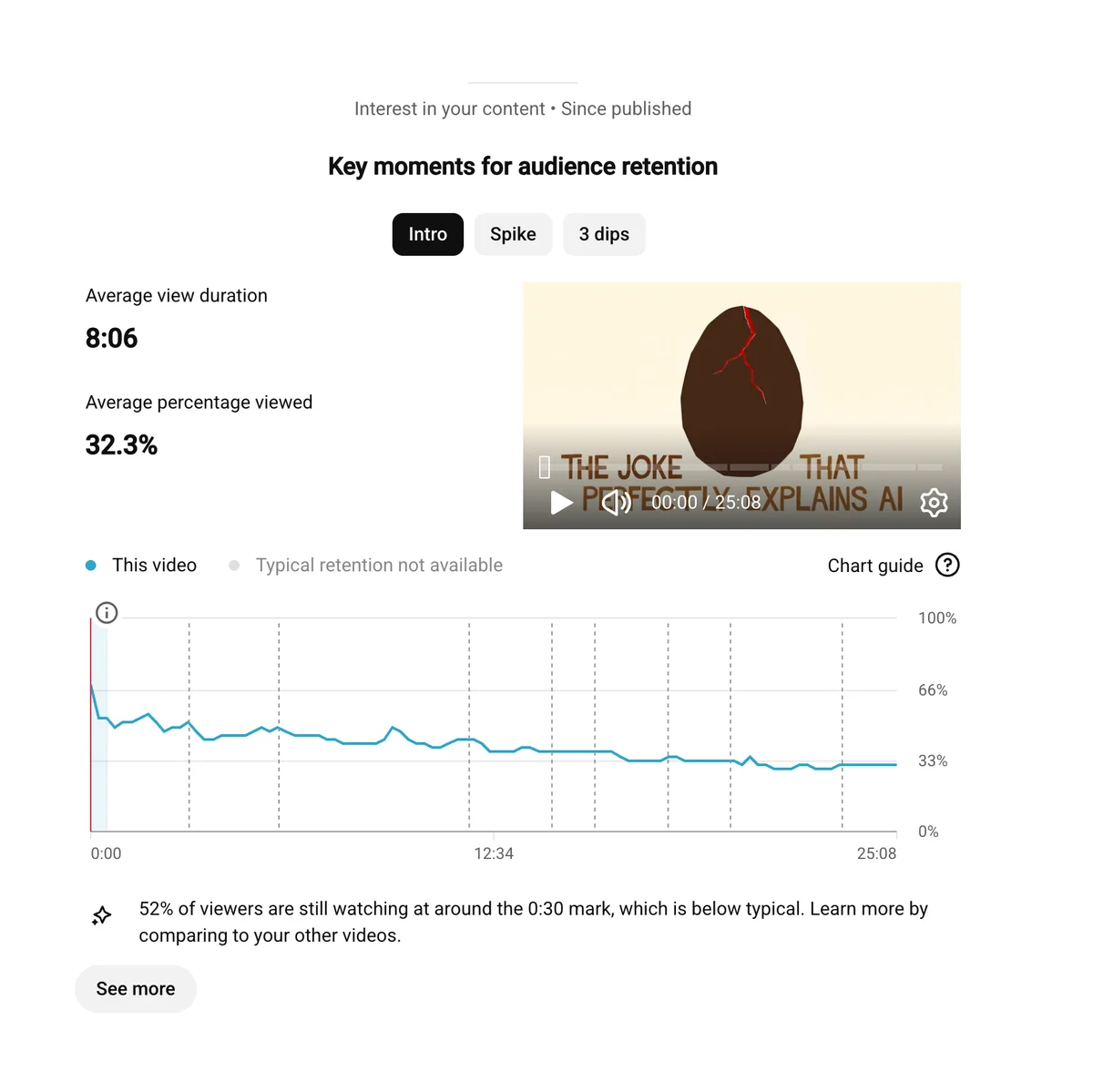
The curve doesn't care how hard you worked. It doesn't know how much hope was attached to the upload.
It simply shows you where people clicked off.
I’ve learned nearly every important lesson about this process that way: publicly, expensively, painfully and after the work was finished.
The double-edged lens
The most upsetting possibility was also the most useful one: perhaps the very thing that distinguishes my work was working against it.
For thirty-five years, I operated inside film and advertising, helping construct images designed to feel natural, immediate, and persuasive. A camera doesn't merely record a world. Someone decides where to place it, what to light, what to exclude, where to cut, and which image should arrive next. The frame doesn't have to contain a lie. Selection alone can reorganize meaning.
That experience became my analytical lens. I notice staging, rhetoric, omissions, strange category changes, and the distance between what a source technically establishes and what the finished story encourages us to believe.
I follow the chain from perception to capital, policy, authority, and physical construction. I try to identify the people responsible without inventing a conspiracy that the evidence can’t support.
That’s one edge of the blade. It produces connections that ordinary beat coverage and conventional fact-checking miss.
The other edge points back at me.
An investigation produces an internal map: names, documents, dates, incentives, qualifications, counterarguments, and causal relationships. After enough time, that map compresses. I can move through it so easily that I forget how many steps were required to build it.
Then I hit publish and the compressed map goes out to someone who’s never seen the terrain.
I experience clarity. When I’ve missed the mark, the viewer experiences... homework.
This is a failure of my entry point. Expertise has hidden the staircase behind me.
I built a manual and mistook it for a door.
The story almost nobody reached
The clearest proof was buried near the end of The Joke That Perfectly Explains AI.
When Jake Moffatt’s grandmother died, he asked a chatbot on Air Canada’s website about bereavement fares. The chatbot told him he could travel and apply for the reduced fare afterward. He followed the instructions. Air Canada then refused the refund and argued, in effect, that it should not be responsible for information supplied by its own chatbot.
The company had allowed the system to speak with institutional authority when a customer was making a purchase. When the answer became costly, that authority somehow disappeared.
The system spoke. Moffatt acted. The company stepped backward.
This story is human, concrete, and immediately recognizable. We’ve all argued with a chatbot. No one needs to understand large language models, AI history, stochastic output, anthropomorphism, or what I call agency laundering before caring about Moffatt’s bad experience with the Air Canada chatbot.
And I introduced it at 20 minutes and 57 seconds.
The average new viewer had clicked off almost fifteen minutes earlier.
The mass audience didn’t reject my strongest story. I had effectively hidden it from them.
Before allowing viewers to experience the problem, I tried to give them the complete conceptual machinery required to explain it. I taught the course and saved the case study for graduation.
That realization hurt. It was also the beginning of a solution.
Two different acts of creation
I now understand the work as two separate passes.
The first is full-resolution inquiry. Follow every relevant branch. Test the premise. Preserve qualifications and counterevidence. Separate fact from inference. Name the people who made recoverable decisions. Build the most accurate map possible.
That’s where the distinctive value originates. Weakening this pass would make the work more accessible by making it less worth accessing.
The second pass must begin from a blank page.
One person. One event. One conflict. One governing question. Context arrives only when the story creates a need for it.
With Air Canada, the correct order is obvious in retrospect. First, a grieving customer follows an airline’s instructions. Then the airline disowns those instructions. Only after the conflict exists do we need terminology for the maneuver.
Experience first. Distinction second. Terminology third.
This is not intellectual dilution. It's another form of construction. Abridgment makes the same map smaller. Translation gives the viewer a door.
The governing principle is now:
Investigate from the endpoint of my own capacity. Communicate from the starting point of the audience’s experience.
The work ahead
The public videos will increasingly provide the door: a human story through which a larger mechanism becomes visible. Member material will preserve more of the map. The Signal Report will go further into the architecture—the documents, contradictions, counterevidence, incentives, and connections that can’t be compressed without destroying the structural advantage they provide.
The paid proposition is not privileged access to certainty. It's disciplined access to the work behind the conclusion. Not another recap of what everyone saw, but an effort to locate the center of gravity the available coverage left obscured.
I can’t promise that every video will escape the choir. Creative work doesn't become predictable merely because the failure has been diagnosed.
I can promise that I'll stop treating complexity as the admission price for encountering what the complexity reveals.
I am profoundly grateful for the choir.
Now I’m learning how to open the cathedral doors.