AI Slop: The Argument We're Not Having
November 14, 2026Seven hours after I published AI Slop: The Argument We're Not Having, the video had attracted 3,800 views and 116 comments. Twelve subscribers had unsubscribed.
For comparison, my recent video, I Asked Claude What Anthropic's IPO is REALLY Worth, has 38,700 views, 120 comments, and generated 75 new subscribers.
The AI Slop video has attracted nearly as many comments with one-tenth the views.
Something has clearly struck a nerve.
I'd published a film about the dangers of letting labels and representations determine what people believe before they've examined the evidence. And the response was a remarkably vivid demonstration of exactly that phenomenon.
Some viewers were furious that I use AI image-rendering tools. Others defended the images. Some said the visuals were unnecessary. Others accused me of hypocrisy, artistic laziness, and outright fraud.
One commenter wrote:
"It gets called slop because it looks the same as the slop. You are definitely using it in a non-slop way, but the style and feeling is the same."
Fair enough. That's an aesthetic judgment. Although it's interesting that the commenter acknowledges the difference between what I'm doing and what they're calling slop, only to dismiss it because of its appearance.
Another wrote:
"Your narration is strong enough to not need visuals. AI or otherwise. Try just you talking."
I appreciate the compliment. But I've spent forty years making images. They're part of how I think, how I investigate things, and how I communicate.
Then there was this:
"Not only the images you use, also your entire scripts are just teleprompted AI-Slop"
And this:
"People view what you are doing as being hypocritical, and that creates a massive TRUST issue."
The central accusation was straightforward: How could somebody who has spent months investigating the AI industry's inflated promises, questionable financing, and environmental consequences actually use the technology?
Well, here's something I didn't make explicit in the video.
I like using Nano Banana 2.
I think it's an outstanding rendering tool. I enjoy using it. And I think it's worth what I pay for it.
I've spent forty years creating images, as an artist and a professional cinematographer. I've worked with film cameras, digital cameras, optical effects, computers, and just about every imaginable method of manipulating photographic images.
When I make visuals for my films, I conceive the image, determine its composition, color scheme, visual references, and purpose. I direct the rendering process. I evaluate what comes back. I revise. I reject. Sometimes I start over entirely.
That's the creative process.
The machine performs the rendering. The ideas and the decisions about what the images are supposed to accomplish come from me.
And in my own work, I haven't encountered evidence of Nano Banana 2 copying somebody else's identifiable images. I'm careful to stay within what I understand to be the boundaries of fair use.
Do I know exactly what material Google used to train the model?
No.
And that’s a question worth investigating.
But I'm not going to pretend I dislike a technology I find extraordinarily useful simply because some people have decided that using it is morally disqualifying.
Nor am I going to pretend that liking the technology means I endorse everything Google—or any other AI company—is doing.
One commenter was particularly emphatic:
"By using AI you are a paying customer. That makes you the problem."
The commenter went on to compare my use of the technology to taking methamphetamine while warning other people not to take it.
There's an interesting leap.
I'm not warning people against using AI technology. I'm investigating an industry that makes extraordinary claims about that technology, the enormous sums of money being committed to it, and the consequences for people who may never use it themselves.
I also happen to think some of the products are excellent.
The commenter appears to believe these positions are mutually exclusive.
I don't.
Who the fuck is Cyrus Rothson!?
Four hours after the video appeared, the most popular comment had nothing to do with the film.
It was about somebody named Cyrus Rothson.
I'd never heard of him.
The comment began:
"ngl i thought the whole cyrus rothson story was just another internet rumor until a friend sent me his leaked chapters last week."
Apparently, Rothson had written explosive revelations about secret histories and a conspiracy to rewrite the world's timeline.
The commenter said reading the names and dates behind this supposed conspiracy had given them chills.
The comment had 54 likes. Three times as many as the most popular comment actually discussing my film.
And there were more. A dozen comments clustered around the same mysterious author and his supposed revelations.
I looked into it.
The trail led to a commercial website selling a book called World's Forbidden Truth. Cyrus Rothson was a pen name. The purported revelations involved the usual assortment of suppressed history and hidden powers.
What appeared to be a spontaneous discussion was promoting a product.
I removed all twelve comments. Hopefully, the reasons are obvious.
Then another commenter announced:
"FYI, your channel started being flagged as AI in the extension AI Channel Blocker - Block AI-generated YouTube content."
The commenter wondered whether the system was being weaponized.
I checked the public AiSList blocklist and warnlist using both my channel handle and its unique YouTube ID.
Nothing. Four searches. Zero matches.
Perhaps some other filtering system has flagged the channel. I haven't seen evidence of it.
But there's something almost comical about all this.
I'd just published a film about perception engineering—how representations become accepted realities, and how labels can substitute for examining evidence.
And within hours, my comments section was apparently being used to manufacture interest in an obscure conspiracy book, while an unverified claim circulated that my channel had been blacklisted for using AI.
The machinery of perception engineering had turned up for a demonstration.
And it didn't disappoint.
I'm not on the pro-AI team. I'm not on the anti-AI team.
I'm interested in what these technologies actually do. What they're good at. What they're bad at. Who benefits. Who pays. Which claims stand up to scrutiny, and which ones fall apart when you examine the evidence.
Sometimes the answers are favorable.
Sometimes they're pretty alarming.
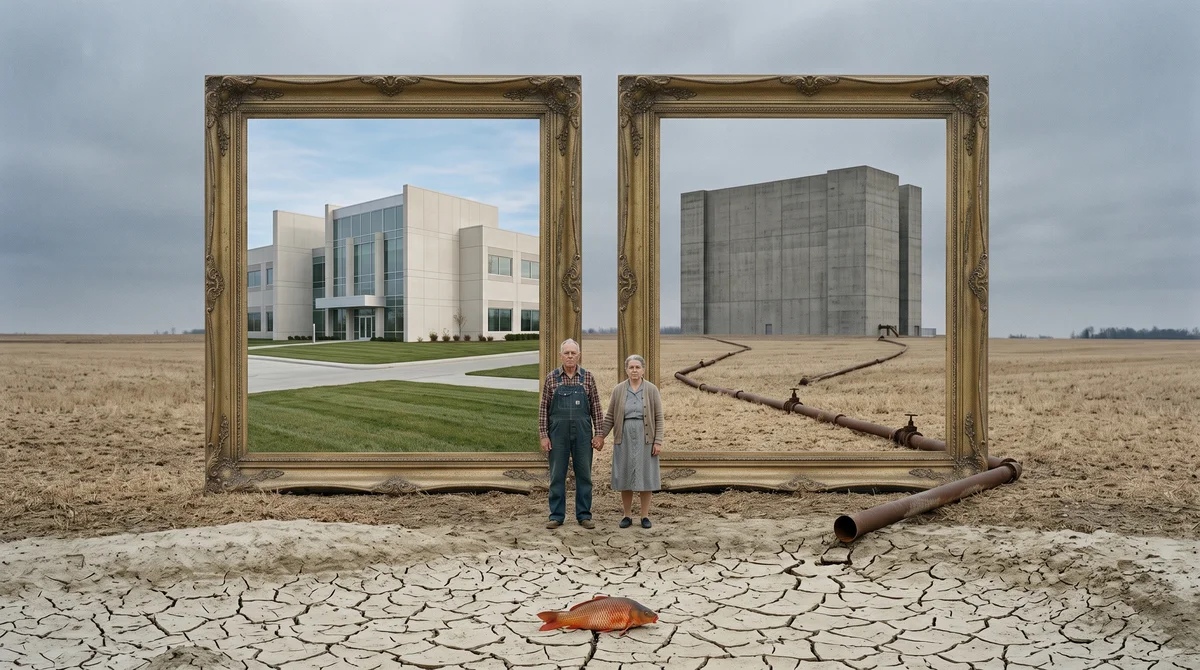
I've made videos investigating the enormous financial risks surrounding the AI buildout, the environmental consequences of data centers, and the extraordinary quantities of money being committed to promises about the future.
And I make those videos using technology supplied by some of the companies I'm investigating.
I pay Google for rendering services. I distribute my work through YouTube, which Google owns. And yes, YouTube pays me.
Between AdSense and channel memberships, I've averaged about $300 a month. I work on this channel full-time.
That's the economic reality of my operation.
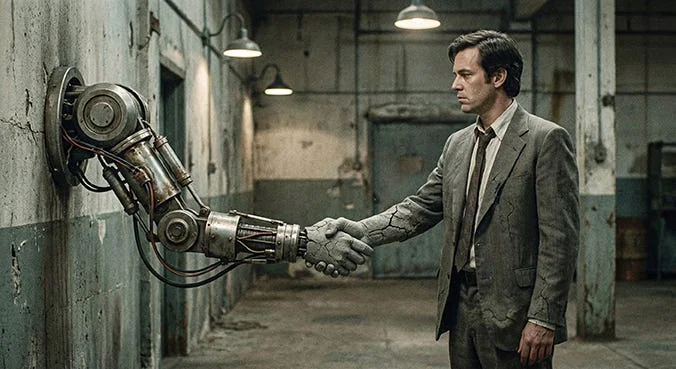
I'm using the machinery to investigate the machinery. And I'm operating inside the machinery while doing it.
I find that interesting. Apparently, some people find it hypocritical.
One commenter put it succinctly:
"A channel who critiques AI and uses AI for its visuals is inconsistent. And people hate inconsistency."
But the inconsistency only exists if you assume that criticizing an industry means opposing its products.
And that assumption is wrong.
Another viewer offered a more perceptive observation:
"to be fair, the anti-AI movement will seek anti-AI content creators that meet specific criteria."
Exactly.
But I'm not an anti-AI content creator.
I never said I was.
I investigate AI, along with the financial, political, technological, and cultural systems surrounding it. And increasingly, the way those systems manufacture and distribute representations of reality.
Some of my conclusions are highly critical. Others aren't.
What remains consistent is the method of investigation.
There's a difference between investigating a subject and campaigning for a predetermined conclusion about it.
I would have thought that distinction was obvious.
Apparently, it’s not.
Which brings me to the question of trust.
One commenter wrote:
"When trust is called into question, then people aren't sure you actually believe what you are saying. It feels like you are just a grifter looking to make money on the upset of others."
I think that gets the whole thing backward.
Trust isn't something you establish by agreeing with your audience. And it certainly isn't something you preserve by pretending to hold convictions you don't actually have.
Artists, innovators, pioneers, and early adopters have been encountering versions of this objection for centuries. New methods challenge established assumptions. Audiences become uncomfortable. Some people leave.
Fine.
Twelve subscribers have left since this video appeared.
I don't celebrate that. But I'm not particularly disturbed by it either.
The actual way I would lose trust is by abandoning my own judgment to keep those people happy.
I'm not interested in doing that.
I'm interested in pursuing a vision, developing it, testing it against reality, and following the evidence wherever it goes. I've spent a lifetime doing that as an artist. I'm doing it now as a filmmaker and analyst.
That doesn't mean I'm always right.
It means I'm responsible for what I say and what I create.
And there's an important difference between retaining an audience and forming one.
If my objective were simply to retain every subscriber, I'd learn what they wanted to hear and give them more of it.
That's a perfectly recognizable business model. Much of the attention economy runs on it.
But it isn't mine.
I'm interested in creating a body of work that reflects a coherent artistic and intellectual vision. Some people will recognize what I'm doing and find it valuable. Others won't.
Over time, the audience sorts itself out.
One commenter was remarkably candid about this:
"I see AI = I close the video. That might be unfair to you personally, but to keep my sanity that's unfortunately a price you'll have to pay."
Well, okay.
The commenter is acknowledging that they're using a categorical shortcut to decide what deserves their attention. And that the shortcut may cause them to reject something worthwhile.
That's their choice.
But I find it interesting that someone can recognize the inadequacy of a judgment and then continue applying it.
Another commenter identified the mechanism even more clearly:
"It has become less a judgment of quality than a marker of belonging."
Precisely.
The word slop can become a way of announcing which side you're on. The label establishes allegiance. The work itself becomes almost incidental.
And that brings us to something considerably more important than whether I retain twelve subscribers.
Trust is not the same as agreement.
Nor is audience approval a reliable measure of intellectual integrity.
I'm interested in developing an audience that values independent judgment, even when it produces conclusions they don't expect or particularly like.
That's not a failure of trust.
It's how a distinctive audience forms.
Who is actually creating this work?
There's another irony in the accusations that my videos are AI-generated.
The accusation mistakes the use of a machine for the absence of an author.
Consider this comment:
"Not only the images you use, also your entire scripts are just teleprompted AI-Slop"
What evidence supports that conclusion?
Apparently, the presence of AI-rendered imagery is enough to justify an assumption about the authorship of the scripts, the analysis, and the entire project.
Look at the editorial position I've established across this channel.
I'm investigating an industry whose products I also use, appreciate, and pay for. I'm criticizing its excesses while recognizing its genuine achievements. I'm following financial arrangements, examining corporate claims, questioning the mythology surrounding artificial intelligence, and using the technology itself to help make those investigations understandable.
And I'm continuing to do it even when some viewers object.
That's a coherent, multifaceted editorial position, informed by decades of experience and expressed through an ongoing series of consequential creative decisions.
A language model can produce sentences arguing for artistic independence. It can imitate an editorial position. It can help research, draft, and revise the language used to express one.
But it didn't conceive the project I've been developing throughout my career. It didn't establish my artistic interests, professional experience, or intellectual commitments. And it isn't the author of the continuing choices that give this work its identity.
Those choices belong to me.
That's the difference between generating text and authoring a body of work.
And it's a distinction that seems to elude people who look at a rendered image and conclude that everything associated with it must have been generated by a machine.
They've identified one part of the production process and assigned authorship of the entire enterprise to it.
Think about that.
Somebody looks at a carefully conceived image, recognizes the characteristic appearance of an AI rendering system, and concludes that no meaningful human intelligence was involved.
Then they extend that assumption to the analysis, the writing, and the entire channel.
They've decided what they're looking at before they've examined it.
Which is exactly what the film is about.
My contention is that authorship resides in the intelligence directing the work, the decisions being made, and the purpose those decisions serve.
A tool doesn't acquire authorship simply because it performs part of the production.
And the fact that a tool is capable of extraordinary things doesn't eliminate the intelligence of the person directing it.
One viewer, who said he'd worked at Adobe, added an interesting bit of professional history:
"I had similar conversations 25 years ago when I worked at Adobe about how Photoshop, Illustrator, and InDesign were taking jobs away from photographers, graphic artists, and typesetters."
I remember those arguments.
I was working in the industry.
The tools changed. The economics changed. Entire professions were disrupted. And artists discovered new ways of working.
Nobody had to declare that creativity itself had become extinct.
The consistency of this channel resides in its editorial method and its continuing intellectual and artistic project.
Not in the machinery used to make the pictures.
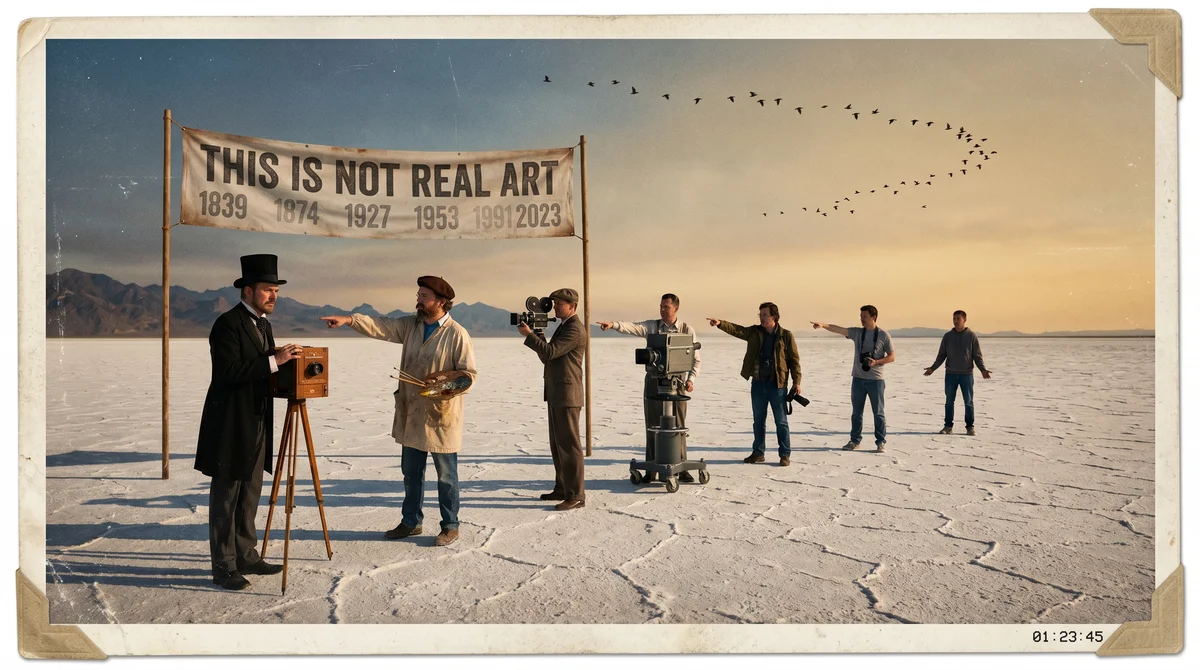
The end of art. Again.
We've reached a peculiar moment when criticizing an industry is taken to mean you must reject its products, while using one of those products is taken to mean you must defend the industry.
It's a remarkably impoverished way of thinking.
The world is more complicated than that. The technologies are more complicated than that. And the economic, artistic, and ethical questions surrounding them are certainly more complicated than that.
The whole point of this channel is to examine those complications rather than squeeze them into the simple narratives we're constantly being sold.
That's why I don't accept the premise that making an image with an AI tool automatically makes it slop. And it's why I don't accept the premise that enjoying an excellent rendering tool obligates me to applaud the corporations supplying it.
That's not a contradiction.
That's the point of this project.
And it brings me to something I've been thinking about as I read the comments.
Here's an extremely short list of innovations and artistic movements that, at one time or another, provoked predictions of cultural catastrophe, fears for established artists, or declarations that art as people knew it was finished:
Impressionism. Photography. Cubism. Ragtime music. Jazz. Talking pictures. Abstract Expressionism. Color film. Color photographs in newspapers. Drum machines. Rap music. Appropriation art. Photoshop. Word processors.
Some changed entire industries. Some eliminated jobs. Some transformed the meaning of artistic skill. Some made previously expensive forms of expression available to millions of people.
And somehow, human creativity survived.
So here's what I'd really like to know.
What, specifically, makes AI image rendering different this time?
How is it that this particular technological development has finally accomplished what all those previous disruptions failed to do?
How has it actually ushered in the end of art, the end of artists, and the extinction of human creativity itself?
I'd like to know.