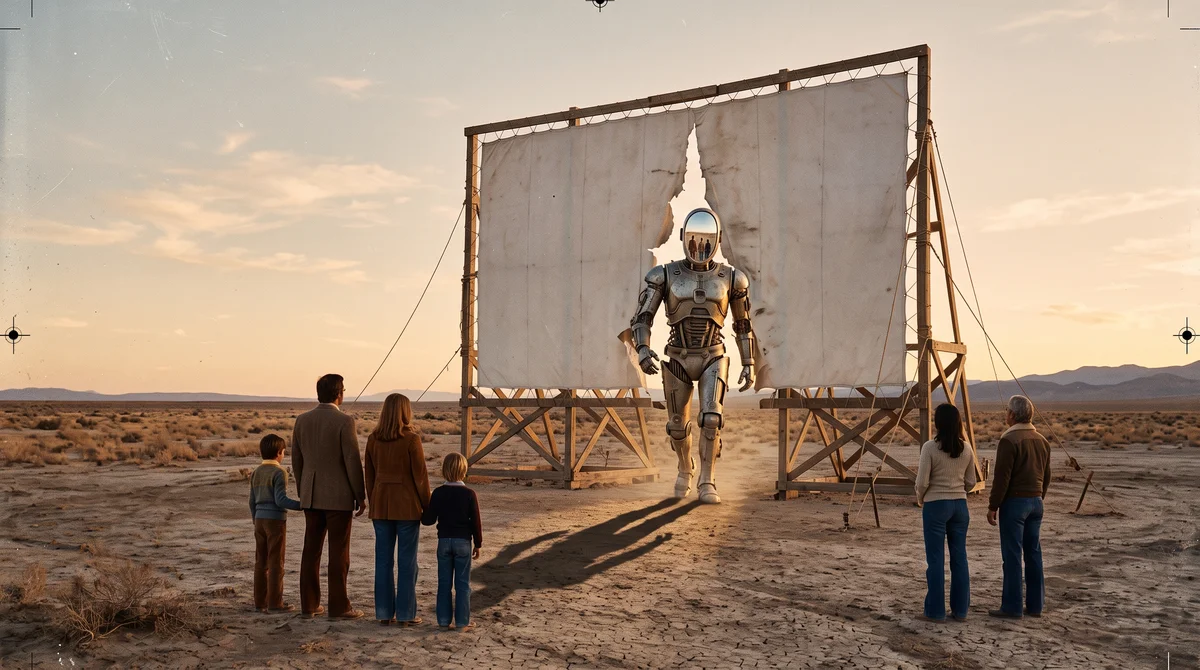
The Worms That Made Me Rethink AI
What a flatworm, a scientific correction, and a YouTube comment section reveal about how we know what's real.
November 19, 2026Free companion to the film | November 18, 2026
What is intelligence?
We've begun reorganizing civilization around something we've decided to call Artificial Intelligence. Yet scientists still haven't agreed on what intelligence fundamentally is.
I've said on my YouTube channel that artificial intelligence doesn't exist. And I meant it. But I've begun to wonder whether I've been applying the wrong test.
And that rather uncomfortable possibility led me to Michael Levin's biology laboratory at Tufts University.
There, researchers are discovering extraordinary things about how groups of cells communicate, retain information, and accomplish goals that no individual cell could accomplish alone.
A tiny flatworm can regenerate an entire body from a fragment. Its cells somehow determine what's missing, replace it, and stop when the job is finished.
No individual cell knows what a complete worm is supposed to look like.
So who's in charge?
And if biological systems can accomplish things like this, what does that tell us about intelligence—and the machines we've decided to call intelligent?
Watch: The Worm That Made Me Rethink AI
The film follows this question from an extraordinary biological experiment toward a much larger possibility: perhaps we've been looking for intelligence in the wrong places.
And perhaps that's why I've begun questioning something I previously believed with considerable confidence.
The investigation doesn't end with the film.
Below, I've examined an even stranger experiment the video didn't cover, corrected an important detail in my account, and considered what happened when the argument reached my audience.
Because there's the evidence. There's what we think the evidence means. And there's what happens when that interpretation enters the world.
The worm that looked normal but wasn't
In 2017, researchers working with Michael Levin discovered something extraordinary about flatworms.
They cut planarian flatworms into pieces and temporarily interfered with electrical communication between their cells.
Some regenerated with two heads instead of one.
But most regenerated with perfectly normal-looking bodies. One head. One tail.
Initially, the researchers assumed those normal-looking worms hadn't been affected by the treatment.
Then they cut them again.
This time, no additional treatment. Just ordinary spring water.
And about 23% of 155 apparently normal worms regenerated with two heads.
The original intervention had taken place as long as eight weeks earlier.
Something had changed inside these animals that wasn't apparent from looking at them.
The researchers found differences in electrical patterns across their tissues. And by manipulating electrical activity again, they could restore normal regeneration in some affected worms.
They called the hidden condition a cryptic phenotype.
Basically, the animals looked perfectly normal, but an experimentally induced change in their biological control system had altered the range of anatomical outcomes they could produce.
Levin describes the underlying electrical organization as a form of pattern memory.
Not memory in the sense of remembering what you had for breakfast.
More like a persistent biological state that influences what the organism will become after an injury.
And these worms weren't all following some hidden instruction to produce two heads. The altered system could produce different outcomes.
The animal's present anatomy didn't necessarily reveal what anatomy it might produce in the future.
That's what the experiment demonstrated.
Whether this kind of information processing should qualify as intelligence is a further question.
And distinguishing those two propositions is rather important.
If this kind of independent investigation helps you see something you couldn't see before, The Signal Report is where I take that work further.
Something I didn't get quite right
There's another experiment in the video involving tadpoles whose facial structures developed in abnormal positions.
I describe how some of those structures took unusual paths toward a normal frog face.
The destination remained remarkably consistent. The route changed.
That was the essential discovery. But after examining the original 2012 research more closely, I found a distinction I should have made clearer.
Not all the facial structures recovered equally well.
The jaws and certain supporting structures showed remarkable correction of their positions and shapes.
The eyes, on the other hand, often remained significantly deformed, even when their positions improved.
And the researchers hadn't physically moved the facial structures. They'd disrupted developmental electrical signaling, causing the abnormalities.
So the evidence demonstrates remarkable developmental adaptability in some structures, but not uniformly across the entire face.
That's the correction. And it illustrates something central to this project.
There's what the experiment demonstrates. There's the interpretation scientists place on those observations. And then there's my representation of their interpretation.
I compressed the evidence for a fourteen-minute film. That compression made the outcome sound more uniform than it actually was.
The distinction belongs in the public account, whether or not it changes the larger philosophical argument.
What are we actually calling intelligence?
Levin proposes that intelligence exists on a continuum.
Rather than looking exclusively for humanlike reasoning, he asks what kinds of goals a system can pursue, how flexibly it can respond to obstacles, and how its capabilities change with experience.
That's a scientific framework for investigating cognition in unfamiliar forms. It isn't a universally accepted definition of intelligence.
And there's a legitimate objection.
If we expand the definition too far, do we eventually reach a point where intelligence describes practically everything?
One viewer raised exactly that concern.
“If you adopt a fit-for-all definition of intelligence, you will always be right in your assertions because almost anything will fit your definition”
— @mariovicente
That's a serious objection. A definition that explains everything may ultimately explain very little.
Interestingly, the same commenter went on to argue that intelligence is a systems property, something that cannot be understood simply by examining individual components.
So there's agreement with part of the investigation, accompanied by skepticism about what conclusions we should draw from it.
Another viewer offered a more mechanical objection.
“In basic programming we have if-else conditions that allow us to adapt and that predates AI.”
— @Mausso
Also fair.
A simple computer program can respond to changing circumstances. That alone doesn't establish sophisticated intelligence.
Levin's framework attempts to distinguish systems by their flexibility, memory, problem-solving capabilities, and the scale of goals they can pursue.
Where we draw those distinctions, and whether they're scientifically useful, remains part of the investigation.
Which is what I thought we were doing.
But then there's another layer to all of this.
The film some viewers heard
One comment struck me for a different reason.
“I am so glad to hear someone challenging that inappropriate name.”
— @julieisthatart
The commenter went on to argue that contemporary AI systems are computers organizing information, rather than intelligent entities.
That response emphasizes the skepticism in my film.
The movement that mattered most to me was my reconsideration of that skepticism.
Both elements are present. But they produce rather different accounts of what the film was about.
And this raises an interesting question.
How much of what we understand from a new argument comes from the argument itself?
And how much comes from what we've already decided to believe?
I'm including these comments because they illuminate different interpretations of the same material, not because I know what motivated the people who wrote them.
There's also a more fundamental problem with treating comments as evidence of what an audience thinks.
The audience we can't see
The people who comment are part of the audience. They aren't a representative sample of it.
A large study of South Korea's Naver News platform examined approximately 260 million comments from 6.2 million users across thirteen years.
A relatively small group of highly active participants produced a disproportionate share of the comments. Greater concentration of participation was also associated with more hostile discourse.
That's research on a news platform in South Korea, not my YouTube channel. We can't simply transfer its statistics to my viewers.
But it demonstrates why the most visible opinions shouldn't automatically be treated as representative of the larger population.
And there's another complication.
In a study known as The Nasty Effect, researchers presented people with the same article about an emerging technology, accompanied by different kinds of reader comments.
The tone of those comments influenced how people evaluated the technology's risks, in ways that depended on their existing beliefs.
The article hadn't changed.
The surrounding commentary had.
So comment sections don't merely record reactions to an argument.
They can influence how subsequent readers interpret it.
And, of course, I'm participating in the same process by selecting particular comments to discuss here.
I'm creating another representation.
The Russian doll is inside another Russian doll.
The question remains open
The flatworm experiments tell us something about how biological systems retain information and coordinate their activities.
Levin proposes that these capacities may help us recognize intelligence in forms we've traditionally overlooked.
My film presents an interpretation of those scientific findings.
And the comments reveal different interpretations of that interpretation.
But they don't tell me what my audience believes. They tell me what some of the people who chose to comment wanted to say.
The larger audience remains mostly invisible.
And this brings us back to the question that started the investigation.
What is intelligence?
I'm not yet convinced that the systems we've decided to call artificial intelligence deserve that designation.
But I'm considerably less certain that my earlier definition of intelligence was adequate.
And perhaps that's an indication of something.
Because there's the observation. There's what we think the observation means. And there's what happens when that interpretation enters the world.
Confuse those things, and it becomes remarkably easy to convince ourselves that we know much more than we actually do.
Sometimes discovering that you may have been asking the wrong question is the beginning of understanding something.
Selected research
Biological intelligence and regeneration
The original cryptic-planaria experiment, documenting persistent, probabilistic changes in regenerative outcomes.
The original study demonstrating substantial but unequal recovery among facial structures.
Michael Levin, 2022 — Technological Approach to Mind Everywhere
Levin's scientific framework for investigating diverse forms of goal-directed cognition.
Understanding online comments
Research documenting how online commenting becomes concentrated among a minority of participants.
Experimental research examining how comment tone interacts with existing beliefs to influence perceptions of scientific risk.
Go further with each film — free
The YouTube films are complete investigations. These companion articles provide a closer look at selected evidence, additional explanations, corrections, and questions that deserve more attention.
Get the free companion articles delivered to your inbox with each new film.
The Signal Report — See what the headlines leave out
Here's the problem with the information environment we're living in.
There's an almost inexhaustible supply of news, opinion, expert predictions, corporate announcements, and increasingly sophisticated explanations of what's happening in the world.
And yet it's remarkably difficult to determine what's actually going on.
Not necessarily because the evidence is hidden. Often it's right there in front of us.
The problem is recognizing which evidence matters, what connects it to everything else, and what the prevailing explanations may be leaving out.
That's what The Signal Report is for.
Each month, I take a consequential question involving AI, markets, finance, technology, or the larger systems shaping our world, and examine it beyond the demands of a YouTube video.
Sometimes that means a complete, deeply researched investigation. Other times it's a concentrated synthesis that connects findings from several investigations and explains what they mean together.
The purpose is the same: to identify the forces and relationships that are difficult to recognize when we're encountering the world one headline, one event, or one argument at a time.
You get the evidence, the competing explanations, my considered assessment, and an understanding of where the uncertainty remains.
Not investment tips. Not predictions dressed up as certainty. And certainly not a promise that I'll always be right.
A more useful way of understanding what's happening—and of recognizing when the prevailing picture may be wrong.
The Signal Report is $10 a month, or $90 a year. Subscribers also receive access to the premium archive.